
500 Calorie Deficit: How Much Weight Will You Actually Lose?
It is the most common dietary advice on the planet. But what does a 500-calorie deficit actually achieve? Here is the exact mathematical breakdown of your weight loss timeline.
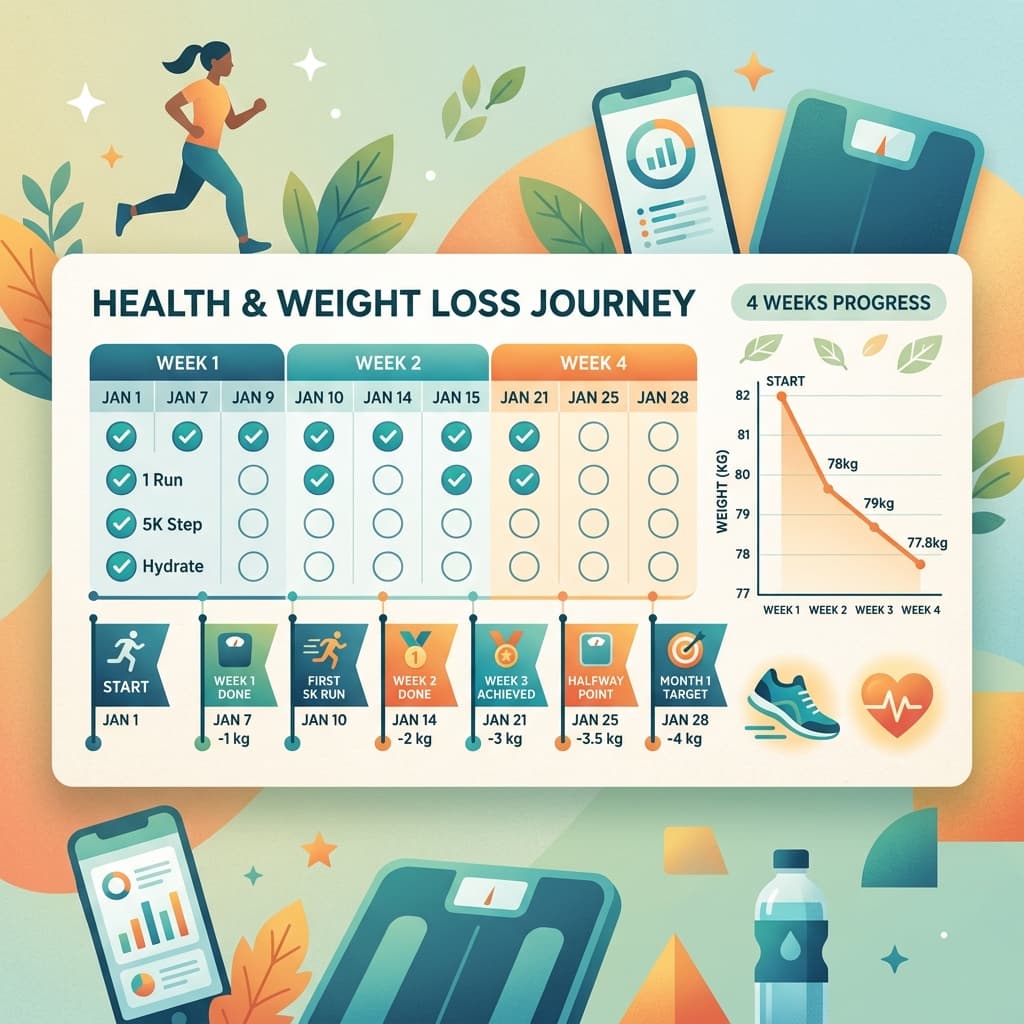
The Golden Rule: 3,500 Calories Equals 1lb of Fat
Before you begin slashing your food intake, you need to understand the biological arithmetic that governs human fat loss. Research tells us that one pound (0.45 kg) of stored human body fat contains approximately 3,500 kilocalories of energy.
To lose that pound of fat, your body must be forced to draw 3,500 calories from its internal reserves rather than from the food you chew.
The Daily Breakdown
This is where the famous "500 calorie" baseline comes from. If we divide that 3,500-calorie requirement by the 7 days in a week, the math aligns perfectly:
Your Weekly and Monthly Weight Loss Timeline
If you strictly adhere to a 500-calorie deficit, your weight loss trajectory is highly predictable. This approach is universally recommended because it is aggressive enough to yield visible results, but mild enough to prevent severe metabolic adaptation and intolerable hunger.
- 1 Week: You will lose 1 pound (0.45 kg) of fat.
- 1 Month (4 Weeks): You will lose 4 pounds (1.8 kg) of fat.
- 3 Months (12 Weeks): You will lose 12 pounds (5.4 kg) of fat.
- 6 Months (26 Weeks): You will lose 26 pounds (11.8 kg) of fat.
Note: During the first 10 days, you may notice a sudden drop of 3 to 5 lbs on the scale. Do not assume your diet is uniquely exceptional; this rapid initial drop is primarily glycogen depletion and associated water weight, not pure adipose tissue (fat).
UK NHS Alignment & Safety
The United Kingdom's National Health Service (NHS) advocates losing weight at a safe, sustainable rate of 0.5kg to 1kg (1lb to 2lbs) a week.
A 500-calorie deficit targets the lower end of this safe zone perfectly. Pushing beyond a 1,000-calorie daily deficit (attempting to lose more than 2lbs a week) dramatically increases the risk of gallstones, muscle catabolism (losing muscle tissue instead of fat), and severe rebound binge eating.
How to Achieve the 500 Calorie Gap
You have three primary levers to pull to achieve this daily target:
- Diet Only: You eat 500 fewer calories than your maintenance TDEE (Total Daily Energy Expenditure). This is entirely diet-controlled.
- Exercise Only: You eat at exact maintenance, but you perform rigorous exercise (e.g., a heavy 45-minute run) to burn an additional 500 calories. This is notoriously difficult to calculate accurately.
- The Hybrid Approach: The most sustainable method. You reduce your food intake by just 250 calories (e.g., swapping a latte for a black coffee and dropping a mid-day snack), and you burn the remaining 250 calories through increased NEAT (Non-Exercise Activity Thermogenesis, like a brisk 30-minute walk).
Step One: Finding Your Maintenance Number
You cannot subtract 500 from a number you do not know.
If you guess your maintenance calories, your deficit becomes a guess. We strongly advise utilizing our clinical-grade Calculator, which leverages the Mifflin-St Jeor equation to provide your exact starting baseline depending on your height, weight, age, and activity level.
Common Questions
How long until I see results on a 500 calorie deficit?
Most people see measurable changes on the scale within the first 10-14 days. However, the first few pounds are often water weight shifting. True fat loss at this rate becomes visibly noticeable after 3-4 weeks.
Is it safe to do a 500 calorie deficit every day?
Yes, for the majority of the adult population, a 500 kcal deficit is the clinical gold standard for safe, sustainable fat loss, provided your total intake does not drop below 1,200 (women) or 1,500 (men) calories.
Should I eat back calories I burn through exercise?
If you used our Calorie Deficit Calculator and factored in your activity level, your TDEE already accounts for those workouts. Eating back the calories you see on a smartwatch often leads to overeating, as trackers notoriously overestimate burned calories by up to 30%.
Written by Dr. Alan Richards
Expert writer and contributor at CalZone, specialized in creating accurate tools and simple guidelines for UK readers.
iSources & References
Calorie Deficit Calculator
Ready to calculate exactly what a 500 calorie deficit looks like for your body? Use our NHS-aligned algorithmic calculator.
Open Calculator FreeExplore CalZone's Free Specialist Calculators
Plan your finances, property renovations, health goals, and daily commute with our 300+ free UK tools.