
Can Astrology Accurately Predict Your Personality?
Does astrology really predict personality? Calzone looks at the science, the psychology and why zodiac traits feel so accurate.
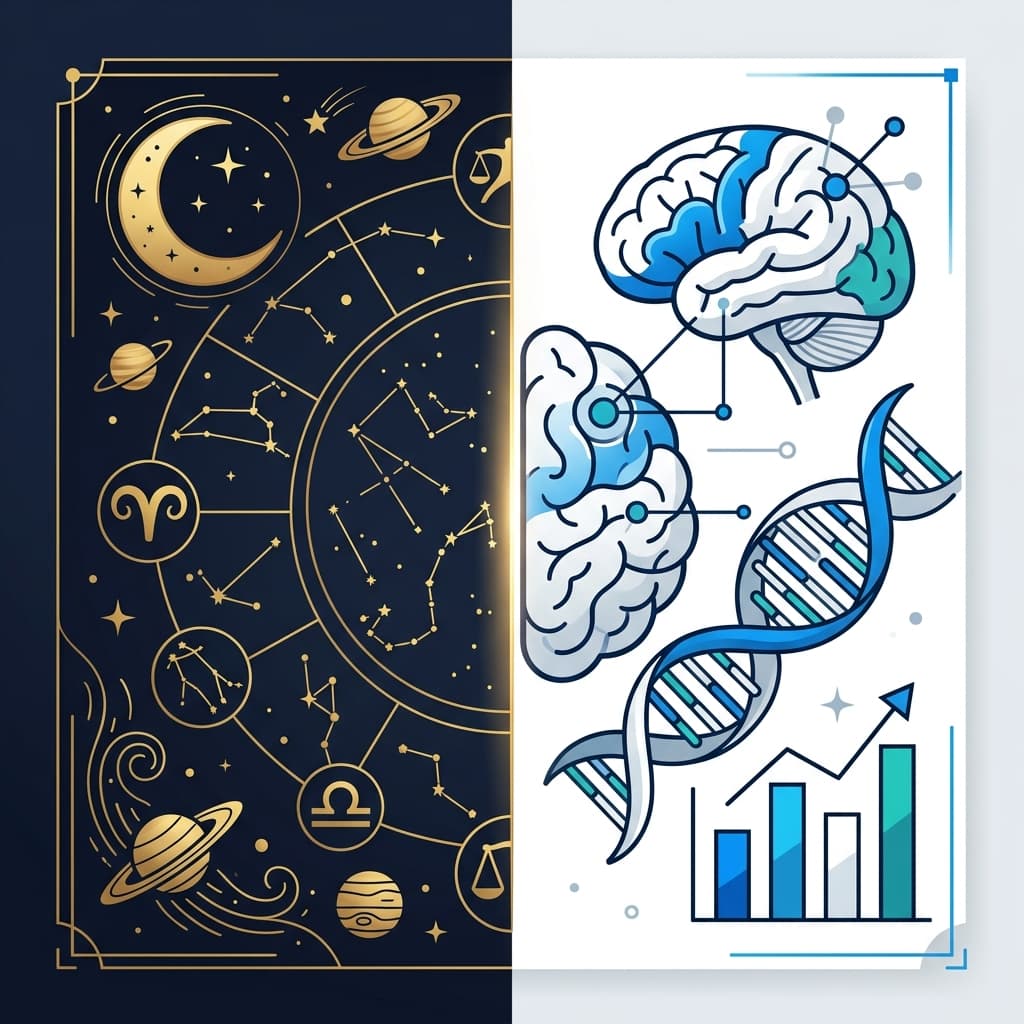
Millions of people read their horoscope, know their "sign," and have at some point said something like "typical Gemini" about a friend. Astrology is everywhere — but does it actually hold up as a way of predicting or explaining personality?
Quick answer: No. When tested under controlled scientific conditions, astrology has not been shown to predict personality traits any better than chance. The reason star signs and horoscopes so often feel accurate comes down to well-documented psychological effects, not celestial influence.
This article looks at what astrology claims, what the actual research shows, and why so many of us still find it uncannily relatable.
What Does Astrology Claim About Personality?
Astrology is the belief that the positions of the sun, moon and planets at the time of your birth influence your character, behaviour and life events. The most familiar version is sun-sign astrology — the twelve zodiac signs (Aries, Taurus, Gemini, and so on) based on where the sun was on your birthday, which is what you'll find in most newspaper and app horoscopes.
A more detailed version is the natal or birth chart, which factors in the exact time and location of your birth to map the position of the moon and planets too, producing a much more individualised (and complex) reading than a simple sun sign.
Both versions share the same core claim: that your personality traits — whether you're outgoing, sensitive, stubborn, or ambitious — are shaped or reflected by these celestial positions.
What Does the Science Actually Say?
Astrology has been tested repeatedly over the past century, and the results are consistent: there's no reliable evidence that it predicts personality.
One of the most well-known tests was a 1985 double-blind study published in the journal Nature, in which professional astrologers were asked to match birth charts to personality profiles for real participants. Despite astrologers' own confidence in the method, they performed no better than random chance at matching charts to the correct person.
Other large-scale studies looking at whether people born under a particular sign show measurably different personality traits — using validated psychological models rather than self-report — have similarly failed to find meaningful correlations. Where small statistical patterns have occasionally turned up, they've generally been explained by other factors, such as cultural expectations around birth season, rather than any astrological mechanism.
In short: across decades of research, astrology has not demonstrated predictive validity for personality in the way genuine psychological assessment tools have. If you are comparing child developmental stages, check our UK School Year Groups Guide or calculate school admission timelines.
Why Do Personality Descriptions Feel So Accurate?
If astrology doesn't work, why does your horoscope sometimes feel like it's describing you perfectly? A few well-established psychological effects explain this:
- The Barnum (or Forer) effect — named after a famous 1948 experiment, this describes our tendency to rate vague, general personality statements as highly accurate and personal, even when the same description is given to everyone. Phrases like "you have a great need for other people to like you, yet you tend to be critical of yourself" feel specific, but apply to almost anyone.
- Confirmation bias — we naturally notice and remember the parts of a horoscope that match us, while quietly forgetting or dismissing the parts that don't.
- Cold reading techniques — many astrological and horoscope descriptions are written using broad, flattering, or emotionally resonant language that's designed to feel personally relevant to a wide audience.
- Self-selection — people who already believe in astrology, or who strongly identify with their sign, are more likely to notice and internalise traits that match the description, reinforcing the belief over time.
Together, these effects create a powerful illusion of accuracy that has nothing to do with the actual position of the planets.
Could There Be Any Psychological Truth to It?
There's one indirect way astrology can shape personality — not through the stars, but through belief itself. If you're told from a young age that you're "a typical Leo" (confident, dramatic, a natural leader), you may unconsciously lean into those traits over time. This is sometimes called a self-fulfilling prophecy, and it's a genuine psychological phenomenon — but it's driven by social expectation and self-identity, not by any planetary mechanism.
Some researchers have also found very small links between birth season and certain outcomes (such as an increased likelihood of specific health conditions), but these are generally attributed to seasonal factors like maternal sunlight exposure or common illness patterns during pregnancy — not personality, and not astrology as it's traditionally practised.
A Brief History of Astrology
Astrology is thousands of years old, with roots in ancient Babylon, where early astronomers tracked celestial movements for agricultural and religious purposes. The Babylonian zodiac was later adopted and expanded by the ancient Greeks, who connected it more explicitly to human character and fate — a tradition that spread through Roman, Islamic and medieval European scholarship.
For much of that history, astrology and astronomy were closely intertwined, with many early astronomers also practising as astrologers. It wasn't until the scientific revolution of the 16th and 17th centuries — as astronomy developed rigorous, testable methods and astrology did not — that the two fields formally split. Astronomy became a recognised science; astrology remained a belief system, and modern scientific testing since then has consistently failed to validate its predictive claims.
That long history explains why astrology feels so culturally embedded even today — it predates modern psychology by well over two thousand years, giving it a depth of tradition and popular familiarity that newer, evidence-based frameworks haven't had the same amount of time to build.
Common Zodiac Personality Claims, Fact-Checked
| Common claim | What the evidence shows |
|---|---|
| "Leos are natural-born leaders" | No controlled study has found birth month or sun sign to predict leadership traits |
| "Virgos are perfectionists" | Perfectionism correlates with upbringing, personality traits like conscientiousness, and life experience — not birth date |
| "Geminis are two-faced or inconsistent" | Personality consistency has been studied extensively; sun sign shows no measurable link to trait stability |
| "Scorpios are intense and secretive" | Traits like emotional intensity vary continuously across the population and don't cluster by birth month |
| "Pisces are highly emotional/intuitive" | Emotional sensitivity is well studied in psychology (e.g. as part of the Big Five trait "neuroticism"), with no tie to zodiac sign |
In every case, the traits themselves are real and recognisable parts of human personality — it's the claimed link to sun sign specifically that fails to hold up when tested.
Astrology vs Legitimate Personality Science
It's a useful comparison to look at how astrology differs from tools psychologists actually use to assess personality:
| Astrology | Established personality science (e.g. Big Five/OCEAN) | |
|---|---|---|
| Basis | Position of celestial bodies at birth | Decades of empirical research and statistical validation |
| Testability | Fails controlled, blind testing | Reliably predicts behaviour patterns across large samples |
| Categories | 12 fixed sun signs | Continuous traits (e.g. openness, conscientiousness) that vary individually |
| Scientific consensus | Not supported as predictive of personality | Widely accepted within psychology, though not without its own debates |
Even popular personality frameworks like the Myers-Briggs Type Indicator (MBTI) face similar criticism from psychologists for weak scientific validity, so astrology isn't uniquely unscientific — it simply sits at the far end of that spectrum, with essentially no empirical support behind its core predictive claims.
So Should You Stop Reading Your Horoscope?
Not necessarily — it depends on what you're using it for. As entertainment, a prompt for self-reflection, or a shared bit of cultural language with friends, astrology is harmless for most people. Many find that thinking through a horoscope or birth chart gives them a structured way to reflect on their mood, relationships or decisions, even if the underlying mechanism isn't real.
Where it's worth being more cautious is if astrology is being used to make significant life decisions — financial, medical, or relationship choices — in place of evidence-based advice. Treating it as one of many casual, low-stakes tools for reflection, rather than a genuine predictive science, is the most balanced way to enjoy it.
At Calzone, we like digging into the psychology and evidence behind the things people believe day-to-day — from horoscopes to money myths — so you can separate what's genuinely useful from what just feels good to read. If you want to plan your actual budgets, check out our Budget Calculator or see how saving rates build wealth with the Savings Calculator UK. You can also explore real-world UK rules with the Equity Release UK Explained Guide where separating myth from evidence is critical.
Written by Sulzax
Expert writer and contributor at CalZone, specialized in creating accurate tools and simple guidelines for UK readers.
iSources & References
Explore CalZone's Free Specialist Calculators
Plan your finances, property renovations, health goals, and daily commute with our 300+ free UK tools.