
How Much Concrete Do I Need? Full UK Calculation Guide
Work out exactly how much concrete you need for your UK project: volume formulas, bag counts, ready-mix costs, and worked examples from Calzone experts.
Quick Answer:
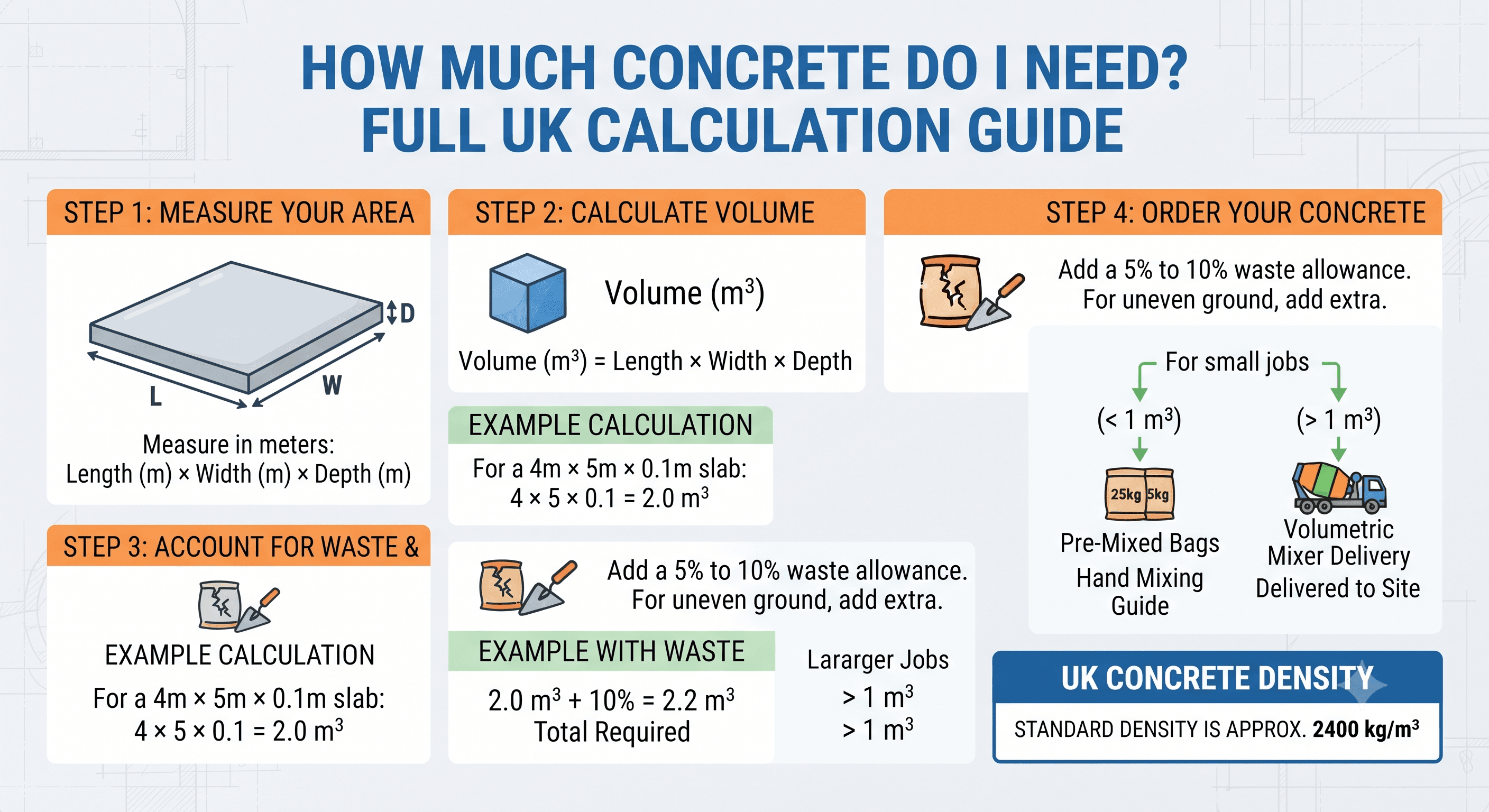
To calculate concrete volume, multiply length × width × depth (all in metres). For example, a 3m × 3m slab at 100mm (0.1m) deep requires 0.9 m³ of concrete. Always add 5–10% extra for waste and uneven ground.
Concrete volume is calculated using simple geometry. For a standard rectangular slab, path, or base:
If your measurements are in millimetres or centimetres, convert them to metres first:
- Millimetres to metres: divide by 1,000 (e.g. 100mm = 0.1m)
- Centimetres to metres: divide by 100 (e.g. 10cm = 0.1m)
Worked Example: A Garden Path
A path measuring 5m long, 1m wide, and 75mm deep:
- Convert depth: 75mm = 0.075m
- Volume = 5 × 1 × 0.075 = 0.375 m³
- Add 10% for waste and uneven ground: 0.375 × 1.1 = approximately 0.41 m³
Calculating Volume for Other Shapes
Not every project is a simple rectangle. Here's how to calculate volume for common shapes:
- Circular slabs or post holes: Volume = π × radius² × depth (use 3.14 for π, and remember radius is half the diameter).
- Fence post holes: For a typical 300mm diameter hole at 600mm deep: 3.14 × 0.15² × 0.6 ≈ 0.042 m³ per hole.
How Much Depth Do You Need?
The correct depth depends entirely on what you're building. These are typical UK depths for common domestic projects:
| Project | Typical Depth |
|---|---|
| Garden path | 75mm |
| Standard shed base / slab | 100mm |
| Driveway | 150mm |
| Garage floor | 150–200mm |
| Strip footing / foundation | 300–450mm |
| Fence post hole | 450–600mm deep |
For anything structural — foundations, load-bearing slabs, or retaining work — always check Building Regulations Approved Document A, and consider getting a structural engineer's specification rather than relying on rule-of-thumb depths.
How Many Bags of Concrete Do You Need?
If you're mixing concrete yourself from bags rather than ordering ready-mix, here's how the numbers work:
- A 25kg bag of pre-mixed concrete yields roughly 0.011–0.0125 m³ of finished concrete.
- That means 1 cubic metre needs approximately 90–96 bags of 25kg concrete.
- A 20kg bag yields around 0.009 m³, meaning you'd need approximately 110 bags per cubic metre.
| Volume Needed | 25kg Bags (approx.) | 20kg Bags (approx.) |
|---|---|---|
| 0.1 m³ | 9–10 | 11 |
| 0.25 m³ | 22–24 | 27 |
| 0.5 m³ | 45–48 | 55 |
| 1.0 m³ | 90–96 | 110 |
As a rule of thumb: bags from a builders' merchant or DIY store are practical for anything under about 0.5 m³. Beyond that, hand-mixing becomes extremely labour-intensive, and ready-mix delivery is almost always the better option.
Should You Use Bags or Order Ready-Mix?
Use bagged concrete when:
- Your total volume is under roughly 0.5 m³.
- You're working on small jobs like fence posts, small repairs, or a single step.
- You need flexibility to mix small batches as you go.
Order ready-mix concrete when:
- Your total volume is over roughly 0.5–1 m³.
- You need consistent quality across a larger pour, such as a driveway or slab.
- You want to save significant time and physical effort.
In 2026, UK ready-mix concrete typically costs around £100–£150 per cubic metre delivered, depending on your region, the concrete specification, and the supplier's minimum order.
Concrete Mix Ratios Explained
The strength and mix ratio you need depends on the job:
| Mix Ratio (Cement : Sand : Aggregate) | Grade | Typical Use |
|---|---|---|
| 1 : 3 : 6 | C10 | Non-structural fill, blinding |
| 1 : 2 : 4 | C20 | Paths, sheds, general domestic use |
| 1 : 1.5 : 3 | C25 | Driveways, garage floors, light foundations |
| 1 : 1 : 2 | C30+ | Structural foundations, heavy-duty slabs |
If you're mixing your own concrete, these ratios are measured by volume, not weight. For anything structural, always confirm the correct mix grade with a professional or your local building control officer.
How Long Does Concrete Take to Set and Cure?
- Initial set: 4–8 hours
- Walkable / light use: 24–48 hours
- Full design strength: 28 days (the standard test age used across the industry)
Disclaimer
This content is for general informational purposes only and does not constitute structural, engineering, or professional building advice. Verify project-specific requirements with a qualified builder, structural engineer, or building control officer, especially for structural or load-bearing work.
Written by CalZone Editorial Team
Expert writer and contributor at CalZone, specialized in creating accurate tools and simple guidelines for UK readers.
iSources & References
Concrete Calculator
Save time on site. Use our free, standard-compliant UK Concrete Calculator to find exact volumes and bags in seconds.
Open Calculator FreeExplore CalZone's Free Specialist Calculators
Plan your finances, property renovations, health goals, and daily commute with our 300+ free UK tools.