
How to Read Your Birth Chart for Personality Insights
Learn how to read your birth chart step by step and discover what your Sun, Moon and Rising signs reveal about your true personality. UK guide.
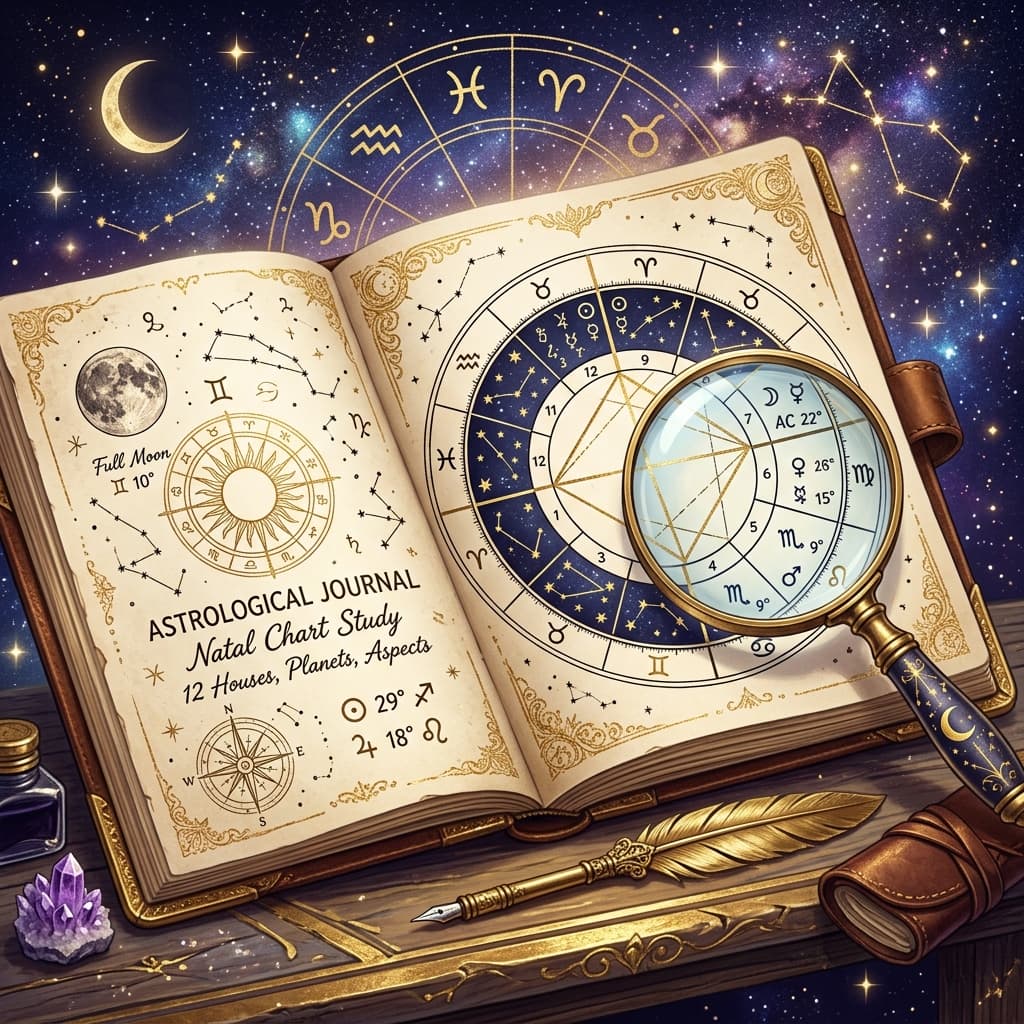
Quick answer: Your birth chart (also called a natal chart) is a map of where the Sun, Moon and planets sat in the sky at the exact moment you were born. To read it for personality insights, start with three points — your Sun sign (your core identity), your Moon sign (your emotional inner world) and your Rising sign (how others see you) — then layer in the planets, houses and aspects for a fuller picture. You don't need to be an expert to start; you just need your birth date, time and location.
If you've ever searched "what does my birth chart mean" or "how do I read my natal chart," you're in the right place. At CalZone, we get asked this almost daily, so we've put together a clear, no-fluff guide to help you actually understand your own chart — not just glance at it and feel confused.
What Is a Birth Chart, Exactly?
A birth chart is a snapshot of the sky at the precise time and place you were born. Astrologers plot the positions of the Sun, Moon, and eight planets against the twelve zodiac signs and twelve astrological houses, creating a personalised wheel that's entirely unique to you — a bit like an astronomical fingerprint.
Unlike a horoscope, which only looks at your Sun sign and applies broad predictions to everyone born in that roughly month-long window, a birth chart is calculated from your exact birth details. That's why two people born on the same day can have noticeably different personalities — their Moon, Rising sign and planetary placements can be completely different depending on the hour and location of birth.
To generate your chart accurately, you'll need:
- Your date of birth
- Your exact time of birth (check your birth certificate if you're unsure)
- Your place of birth (city and country)
If you don't know your birth time, you can still get useful insights from your Sun and Moon signs, but your Rising sign and house placements won't be accurate without it.
The Three Pillars: Sun, Moon and Rising
Before diving into the finer details, most beginners focus on what astrologers call the "Big Three." These give you a solid personality snapshot on their own.
Sun Sign: Your Core Identity
This is the sign most people already know — it's what's typically meant by "I'm a Gemini" or "I'm a Taurus." Your Sun sign represents your core sense of self, your ego, and the general direction your personality tends to grow in. It's about who you're becoming, not just how you act day to day.
Moon Sign: Your Emotional World
Your Moon sign reflects your inner emotional landscape — how you process feelings, what makes you feel secure, and how you instinctively react under stress. Many people find their Moon sign feels more "them" than their Sun sign, especially in private or emotionally intense moments. You can calculate yours using our Moon Sign Calculator.
Rising Sign (Ascendant): Your Outer Mask
Your Rising sign is the zodiac sign that was ascending on the eastern horizon at your exact birth time. It shapes your first impressions, your general demeanour, and often your physical presentation. This is why your Rising sign requires an accurate birth time — it shifts roughly every two hours. Find yours using our Rising Sign Calculator.
Understanding the Planets in Your Chart
Beyond the Sun and Moon, each planet governs a different part of your personality:
- Mercury — communication style, thought patterns, how you learn
- Venus — love language, aesthetic taste, what you value
- Mars — drive, ambition, how you handle conflict
- Jupiter — growth, luck, where you tend to overdo things
- Saturn — discipline, boundaries, life lessons and responsibilities
- Uranus — individuality, rebellion, sudden change
- Neptune — imagination, intuition, spirituality, illusion
- Pluto — transformation, power, deep psychological patterns
Each of these planets sits in one of the twelve zodiac signs in your chart, which colours how that energy expresses itself. Mars in Aries, for instance, tends to be far more direct and impulsive than Mars in Cancer, which channels drive more protectively.
What Are the Astrological Houses?
If the zodiac signs describe how an energy behaves, the twelve houses describe where in your life it shows up. Each house governs a different life area:
- 1st House — self-image, identity, first impressions
- 2nd House — money, possessions, self-worth
- 3rd House — communication, everyday learning, short trips
- 4th House — home, family, emotional roots
- 5th House — creativity, romance, self-expression
- 6th House — daily routines, health, work habits
- 7th House — partnerships, marriage, one-to-one relationships
- 8th House — intimacy, shared resources, transformation
- 9th House — travel, beliefs, higher learning
- 10th House — career, public reputation, ambition
- 11th House — friendships, community, future goals
- 12th House — subconscious, rest, hidden patterns
So if your Venus falls in your 10th House, for example, love of beauty and harmony might show up strongly in your career or public reputation, rather than just in romantic relationships.
Elements and Modalities: The Bigger Patterns
Once you've located your planets, it helps to step back and look at the bigger patterns across your whole chart — specifically the elements and modalities each sign belongs to.
The four elements:
- Fire (Aries, Leo, Sagittarius) — energetic, passionate, action-driven
- Earth (Taurus, Virgo, Capricorn) — practical, grounded, security-focused
- Air (Gemini, Libra, Aquarius) — communicative, social, idea-driven
- Water (Cancer, Scorpio, Pisces) — emotional, intuitive, sensitive
If several of your planets cluster in one element, that quality tends to dominate your overall temperament. A chart heavy in Air signs, for example, often points to someone who processes the world through conversation and ideas rather than gut feeling.
The three modalities:
- Cardinal (Aries, Cancer, Libra, Capricorn) — initiators, natural leaders, comfortable starting new things
- Fixed (Taurus, Leo, Scorpio, Aquarius) — steady, determined, resistant to change once committed
- Mutable (Gemini, Virgo, Sagittarius, Pisces) — adaptable, flexible, prone to changing course
Looking at your chart's overall balance of elements and modalities often reveals more about your general temperament than any single placement does on its own. It's one of the quickest ways to move from "reading individual symbols" to genuinely understanding the shape of a chart.
How to Actually Read Your Chart, Step by Step
- Get an accurate chart calculated: You'll need your birth date, time and location entered correctly — even a small time error can shift your Rising sign and house placements.
- Start with the Big Three: Identify your Sun, Moon and Rising signs first. This gives you a foundation before anything else.
- Look at where your personal planets sit: Mercury, Venus and Mars tell you about communication, love and drive.
- Check which houses your planets fall in: This shows where in life those traits play out most strongly.
- Notice any aspects: Aspects are the angles planets make to one another (conjunctions, squares, trines, oppositions). Tight aspects — especially conjunctions and oppositions — tend to be the most noticeable in daily life.
- Look for patterns, not single placements: A chart with several planets in Water signs (Cancer, Scorpio, Pisces) will feel more emotionally driven overall, regardless of any single placement.
- Read holistically: No single sign or planet defines you — it's the combination that creates your full personality picture.
Common Mistakes Beginners Make
- Relying only on the Sun sign: This is the single biggest reason people say "my horoscope doesn't sound like me at all" — the Sun is only one piece of a much bigger puzzle.
- Guessing the birth time: Even a 15–30 minute error can change your Rising sign and shift entire houses.
- Ignoring the Moon: Many people resonate more strongly with their Moon sign than their Sun sign, particularly for emotional patterns.
- Treating placements as fixed labels: A chart describes tendencies and potential, not a rigid script you're locked into.
Why Your Birth Chart Feels So Personal
Because a birth chart is calculated from an exact date, time and place, no two charts are identical unless two people were born minutes apart in the same location. This is part of why chart reading feels so much more accurate to people than generic sun-sign horoscopes — it's built entirely around you, not a generalised group of millions of people sharing a birth month.
At CalZone, we see birth chart reading as a tool for self-reflection rather than prediction. It's less about "what will happen to me" and more about "why do I respond to life the way I do." Used that way, your chart becomes a genuinely useful lens for understanding your habits, relationships and decision-making style.
Ready to Explore Your Own Chart?
Understanding your birth chart is a skill that builds over time — the more charts you look at (starting with your own), the more the patterns start to click. If you'd like a personalised breakdown of your Sun, Moon, Rising and full planetary picture, head over to CalZone to get started with your own reading.
Want a professional, personalised breakdown of your birth chart? Explore readings with CalZone and get insights tailored to your exact birth details using our Sun, Moon, Rising Calculator.
Written by Sulzax
Expert writer and contributor at CalZone, specialized in creating accurate tools and simple guidelines for UK readers.
iSources & References
Sun, Moon, Rising Calculator
Ready to map out your own Big Three and planetary placements? Get a personalised birth chart breakdown with our free calculator.
Open Calculator FreeExplore CalZone's Free Specialist Calculators
Plan your finances, property renovations, health goals, and daily commute with our 300+ free UK tools.