
Redundancy Pay UK: How Much Will You Get?
How statutory redundancy pay works in the UK: who qualifies, the age-based formula, the weekly pay cap, tax treatment and a worked example.
Being told your job is at risk is stressful, and the first practical question is usually how much money you are entitled to. In the UK there is a legal minimum called statutory redundancy pay. This guide explains who qualifies, how the formula works, and what to check before you sign anything.
Who qualifies for statutory redundancy pay?
You must be an employee (not self-employed) and have at least two years of continuous service with your employer. Agency workers and some other worker categories may not qualify. If your employer offers more than the legal minimum in your contract or a settlement agreement, that higher figure applies instead.
Voluntary redundancy counts the same as compulsory redundancy for statutory pay, as long as your employer agrees to the arrangement and you meet the qualifying rules.
How the formula works
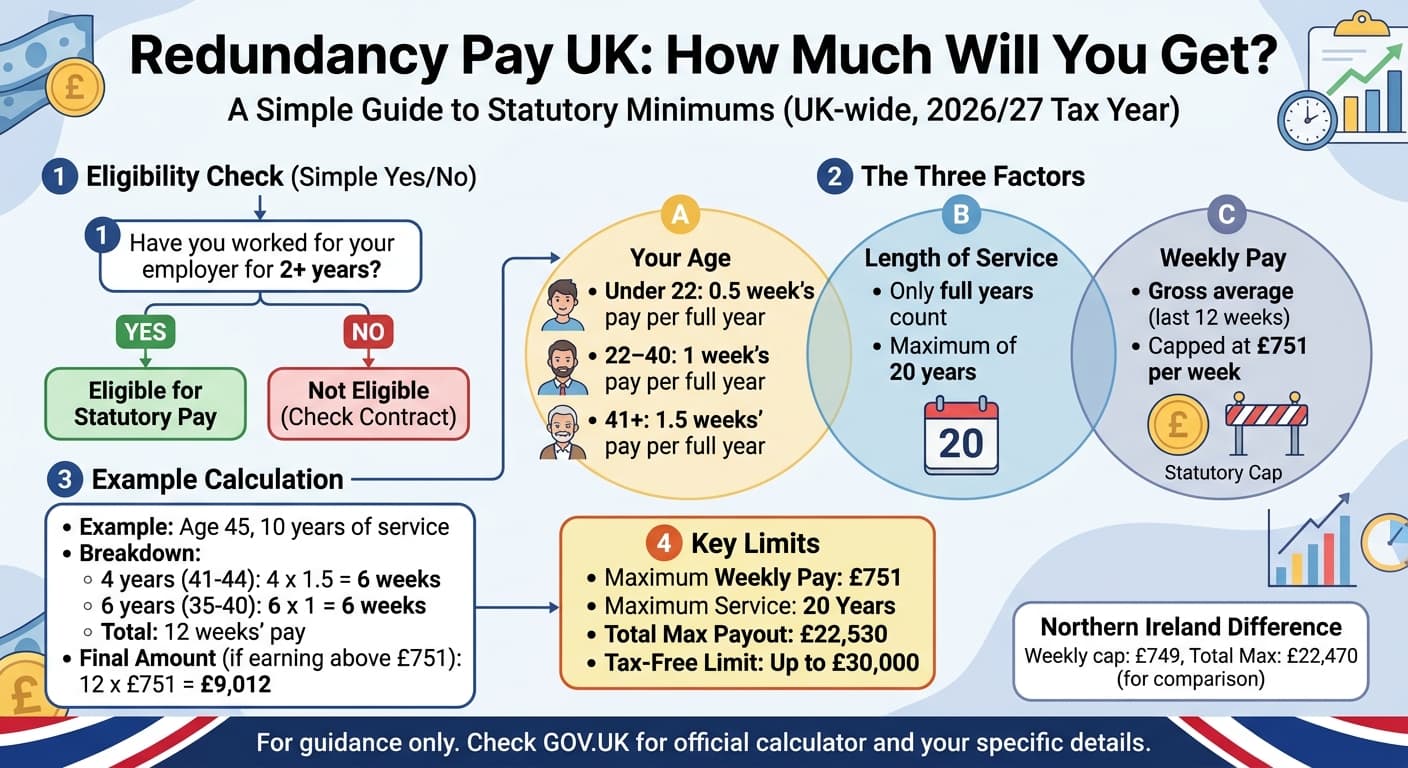
Statutory redundancy pay is based on your age during each year of service, counting backwards from your dismissal date and up to a maximum of 20 years:
- 0.5 weeks of pay for each full year of service when you were under 22
- 1 week of pay for each full year when you were 22 to 40
- 1.5 weeks of pay for each full year when you were 41 or older
Your weekly pay used in the formula is capped by law. The calculator on CalZone uses a cap of £751 a week, which makes the maximum statutory payment £22,530 (30 weeks at £751). Always check the current cap on GOV.UK because it is reviewed every April.
Worked example
Imagine you are 45, have worked for the same employer for 10 full years and earn £800 a week. Your weekly pay is capped at £751. All 10 years fall in the 41-plus bracket, so you receive 10 x 1.5 = 15 weeks of pay.
15 weeks x £751 = £11,265. Without the cap you might expect 15 x £800 = £12,000, so the cap costs you £735 in this case.
Try your own numbers in the Redundancy Calculator UK.
Is redundancy pay taxed?
Statutory redundancy pay is tax-free up to £30,000 in total. Anything above this, including some non-contractual payments in lieu of notice, can be taxed as earnings. Holiday pay owed and your notice pay are separate and are taxed normally.
What to check before you accept
Ask for a written breakdown showing your age, service dates and weekly pay used. Check that unused holiday is paid, that your notice period is respected, and whether your contract promises an enhanced redundancy scheme. If you are pregnant, on maternity leave or recently returned, you have extra protection and should be offered any suitable alternative vacancy first.
If the figures look wrong, ACAS offers free, impartial guidance, and you can challenge a decision at an employment tribunal. For large or complicated packages, speak to a solicitor or your union before signing a settlement agreement.
Frequently Asked Questions
How long do I need to work to get redundancy pay?
You need at least two years of continuous service with your employer to qualify for statutory redundancy pay.
Is there a maximum statutory redundancy payment?
Yes. Weekly pay is capped and service is limited to 20 years, so the statutory maximum is 30 weeks of capped pay. Your contract may offer more.
Do I pay tax on redundancy pay?
Statutory and most genuine redundancy payments are tax-free up to £30,000. Amounts above that are taxed as earnings.
Does notice pay count as redundancy pay?
No. Notice pay and unused holiday pay are separate and are taxed as normal earnings.
This article is for general information only and is not financial, legal or medical advice. Rules and figures change, so check the official sources below and speak to a qualified adviser for decisions that matter.
Written and reviewed by Sulzax, founder of CalZone
Sulzax builds and maintains CalZone's UK calculators and guides. Every formula is checked against published figures from HMRC, GOV.UK and the NHS, and tested with worked examples before publication. Found an error? Email info@thecalzone.co.uk.
iSources & References
Redundancy Calculator UK
Estimate your statutory redundancy pay from age, service and weekly pay.
Open Calculator FreeExplore CalZone's Free Specialist Calculators
Plan your finances, property renovations, health goals, and daily commute with our 300+ free UK tools.