
What Is a Healthy BMI Range for UK Adults?
BMI is one of the most widely used screening tools for weight-related health risk, but it's a starting point rather than a diagnosis. Here is what the NHS BMI categories actually mean in 2026.
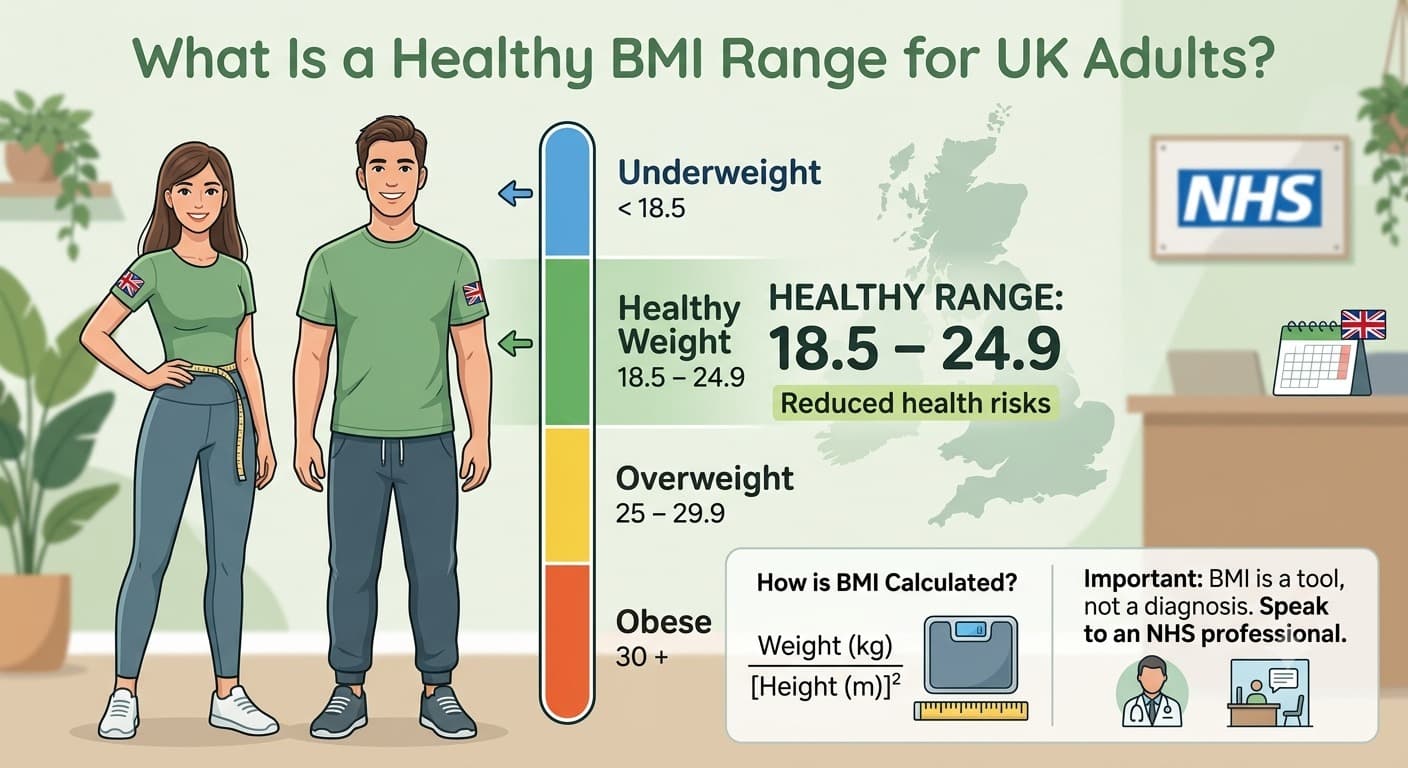
For most UK adults, a healthy BMI (Body Mass Index) falls between 18.5 and 24.9. Below 18.5 is classed as underweight, 25 to 29.9 as overweight, and 30 or above as obese. The NHS uses lower thresholds for adults of South Asian, Chinese, other Asian, Middle Eastern, Black African, or African-Caribbean family background, where overweight starts at 23 and obesity at 27.5, reflecting higher health risks at lower BMIs in these groups.
Here's what the NHS BMI categories actually are, why the thresholds differ by ethnicity, and where BMI falls short as a measure. You can check your own figure using CalZone's free BMI calculator.
The Short Version: NHS BMI Categories
| BMI | Category (Standard Thresholds) |
|---|---|
| Below 18.5 | Underweight |
| 18.5–24.9 | Healthy weight |
| 25–29.9 | Overweight |
| 30–34.9 | Obese (Class I) |
| 35–39.9 | Obese (Class II) |
| 40 and above | Severely obese (Class III) |
These are the standard thresholds used across NHS public health guidance, based on World Health Organisation classifications, and apply to adults aged 20 and over.
How BMI Is Calculated
BMI is calculated using a simple formula:
For example, someone weighing 75kg at a height of 1.75m would calculate: 75 ÷ (1.75 × 1.75) = 24.5, which falls within the healthy weight range.
If you're working in stones, pounds, and feet rather than metric units, it's usually easier to use a calculator than to convert manually, since the height figure needs to be squared in metres.
Why the NHS Uses Different Thresholds for Some Ethnic Groups
The standard BMI categories were developed primarily from research on White European populations. Following NICE guidance, the NHS applies lower BMI thresholds for adults of South Asian (including Indian, Pakistani, Bangladeshi, and Sri Lankan background), Chinese, other Asian, Middle Eastern, Black African, or African-Caribbean family background:
| BMI | Category (Ethnicity-Adjusted Thresholds) |
|---|---|
| Below 18.5 | Underweight |
| 18.5–22.9 | Healthy weight |
| 23–27.4 | Overweight |
| 27.5 and above | Obese |
This adjustment reflects consistent evidence that these populations tend to carry a higher proportion of body fat, particularly visceral fat, at the same BMI as White European adults — and that associated risks for type 2 diabetes and cardiovascular disease emerge at lower BMI levels as a result.
In practical terms, this is clinically meaningful: an adult of South Asian background with a BMI of 24.5 sits within the standard healthy range but above the adjusted overweight threshold.
Where BMI Falls Short as a Measure
BMI is a useful population-level screening tool, but it has well-documented limitations for certain groups:
- Muscular Individuals: BMI doesn't distinguish between muscle and fat. Athletes and people who do regular resistance training can have a BMI in the 25–29.9 "overweight" range while carrying very low body fat and having excellent metabolic health.
- Older Adults: BMI thresholds don't officially change with age, but clinical interpretation can differ for adults over 65. Some clinical guidance treats a BMI up to around 27 as acceptable in this age group, since slightly higher body weight can have a protective effect against frailty in later life.
- Where Fat Is Stored: BMI doesn't measure fat distribution. A person can have a healthy BMI while carrying excess visceral fat — the fat around internal organs that carries the most health risk — and conversely, a person in the "overweight" category isn't automatically at higher health risk if that weight is largely muscle.
- Pregnancy: BMI is not used to assess weight during pregnancy, since weight gain during this time is expected and healthy.
A Useful Complement to BMI: Waist-to-Height Ratio
Because BMI doesn't capture where fat is stored, combining it with a waist measurement gives a fuller picture. A simple guide many clinicians use is the waist-to-height ratio: keeping your waist circumference below half your height is generally considered a reasonable target, regardless of your BMI category. A waist-to-height ratio above 0.5 is treated as a signal worth paying attention to, even in someone whose BMI falls in the healthy range.
BMI for Children and Teenagers
Standard adult BMI categories do not apply to children and teenagers. Instead, the NHS uses BMI percentile charts that account for age and sex, since a healthy BMI naturally differs at different stages of growth. The National Child Measurement Programme (NCMP) measures BMI in children in Reception (age 4–5) and Year 6 (age 10–11) as part of monitoring population health trends, using percentile bands rather than the fixed thresholds used for adults.
What to Do If Your BMI Falls Outside the Healthy Range
BMI is a screening tool, not a diagnosis. If your BMI falls outside the healthy range for your relevant thresholds, it doesn't automatically mean there's a health problem — but it can be a useful prompt to have a broader conversation with a GP or practice nurse, who can consider your BMI alongside other factors like waist circumference, family history, blood pressure, and blood test results before making any recommendations specific to you.
Checking Your Own BMI
Because BMI depends on precise height and weight, and the relevant thresholds depend on ethnic background, the simplest way to check where you fall is to use a calculator rather than working it out by hand. CalZone's BMI calculator applies both the standard and ethnicity-adjusted NHS thresholds, and is part of a wider set of free UK health calculators available at calzone.co, including tools for waist-to-height ratio, calorie needs, and other general health measures.
This guide reflects NHS and NICE public health guidance on adult BMI categories in the UK. BMI is a screening tool, not a diagnosis, and doesn't account for every individual factor affecting health. It's provided for general information only and doesn't constitute personal medical advice — for guidance specific to your own health, speak to your GP or a registered healthcare professional.
Common Questions
What is a healthy BMI range for UK adults?
For most UK adults, a healthy BMI is between 18.5 and 24.9. For adults of South Asian, Chinese, other Asian, Middle Eastern, Black African, or African-Caribbean family background, the NHS uses a lower healthy range of 18.5 to 22.9, since health risks emerge at lower BMIs in these groups.
Is a BMI of 25 overweight?
For most adults, yes — a BMI of 25 marks the start of the overweight range under standard NHS thresholds. For some ethnic backgrounds, the overweight threshold is lower, starting at BMI 23.
Is a BMI of 30 obese?
For most adults, yes. A BMI of 30 or above falls into the obese range under standard NHS thresholds. For adults of South Asian, Chinese, or other Asian and Black African/African-Caribbean background, the obesity threshold is lower, starting at BMI 27.5.
Does BMI apply the same way to children as adults?
No. Children and teenagers are assessed using BMI percentile charts that account for age and sex, rather than the fixed adult categories of underweight, healthy, overweight, and obese.
Is BMI accurate for muscular people?
Not always. BMI doesn't distinguish between muscle and fat, so very muscular adults, including athletes and regular strength trainers, can register as "overweight" on the BMI scale despite having low body fat and good metabolic health.
Why does the NHS use different BMI thresholds for some ethnic groups?
Research consistently shows that adults of South Asian, Chinese, other Asian, Middle Eastern, Black African, or African-Caribbean background tend to carry more visceral fat at the same BMI as White European adults, and face higher risk of type 2 diabetes and cardiovascular disease at lower BMI levels. The NHS applies lower thresholds for these groups to reflect this earlier risk.
Written by Sulzax
Expert writer and contributor at CalZone, specialized in creating accurate tools and simple guidelines for UK readers.
iSources & References
BMI Calculator UK
Want to calculate your exact BMI and view your NHS weight range? Use our free BMI Calculator UK.
Open Calculator FreeExplore CalZone's Free Specialist Calculators
Plan your finances, property renovations, health goals, and daily commute with our 300+ free UK tools.