
What Is a Calorie Deficit? How to Calculate Yours (UK Guide)
Learn what a calorie deficit is and how to calculate yours step by step, using NHS-aligned UK guidance, TDEE formulas and CalZone's free calculator tool.
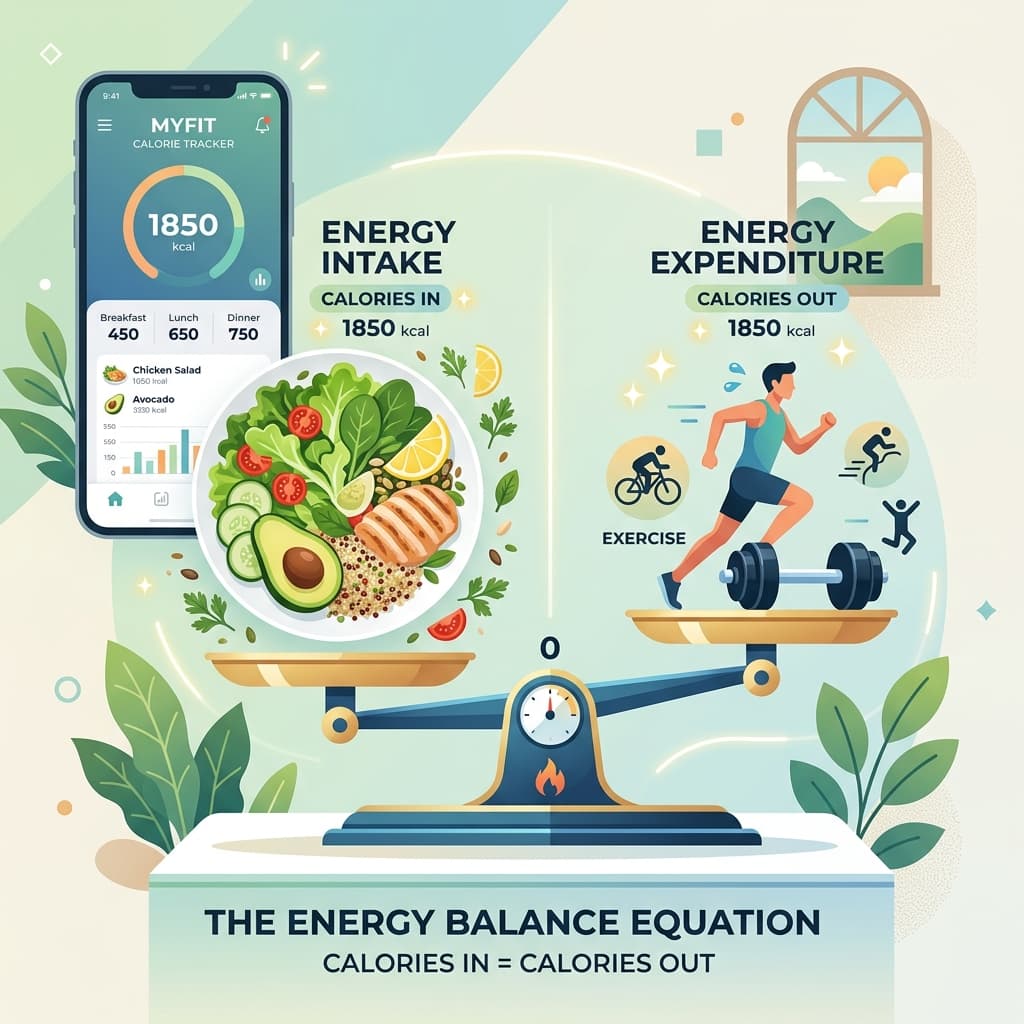
A calorie deficit happens when you eat and drink fewer calories than your body burns in a day, forcing it to use stored fat for energy and causing weight loss. To calculate yours, work out your Total Daily Energy Expenditure (TDEE), then eat 500–600 kcal less than that number — the range recommended by the NHS for safe, sustainable weight loss of roughly 0.5–1 kg per week. You can skip the maths entirely with CalZone's free Calorie Deficit Calculator, built specifically for UK users.
If you've ever searched "how many calories should I eat to lose weight" or "what is a calorie deficit," you're asking the right question first. Before any diet plan, workout split, or macro tracker matters, understanding your calorie deficit is the foundation everything else is built on. At CalZone, we help users track their nutrition, check healthy weight brackets with our BMI Calculator UK, or design healthy daily routines.
This guide breaks down exactly what a calorie deficit is, the science behind it, and a step-by-step method to calculate your own — using the same NHS-aligned approach built into CalZone's calculators.
What Is a Calorie Deficit?
A calorie deficit is simply the gap between the energy (calories) you consume through food and drink, and the energy your body uses up each day through breathing, digestion, movement, and exercise. When intake is lower than expenditure, your body draws on stored energy — mainly body fat — to make up the difference. Over time, that shortfall shows up on the scales as weight loss.
It's the same principle in reverse for weight gain: eat more calories than you burn (a calorie surplus), and your body stores the extra energy. Eat exactly what you burn, and your weight stays roughly stable — this is called maintenance calories.
- Calorie deficit: eating less than you burn → weight loss
- Calorie surplus: eating more than you burn → weight gain
- Maintenance: eating the same as you burn → stable weight
How Does a Calorie Deficit Actually Work?
Your body needs energy for three main things:
- Basal Metabolic Rate (BMR): the calories your body burns at complete rest just to keep organs functioning, your heart beating, and cells repairing. This typically accounts for 60–75% of total daily energy use.
- Physical activity: everything from walking and fidgeting (NEAT) to structured exercise like gym sessions or running.
- Thermic Effect of Food (TEF): the energy used to digest, absorb, and process what you eat, roughly 10% of intake.
Add these together and you get your Total Daily Energy Expenditure (TDEE) — the actual number of calories your body burns in a day. A calorie deficit exists whenever your intake sits below this TDEE figure. One kilogram of body fat holds roughly 7,700 kilocalories, which is why a consistent daily deficit is needed to see meaningful, sustained fat loss rather than short-term water weight changes. If you want to configure daily calorie goals, explore our How Many Calories to Eat Guide or calculate your targets with the Calorie Deficit Calculator.
How to Calculate Your Calorie Deficit: Step by Step
Step 1: Calculate Your BMR
The most widely used and clinically validated formula is the Mifflin-St Jeor equation:
- Men: BMR = (10 × weight in kg) + (6.25 × height in cm) − (5 × age) + 5
- Women: BMR = (10 × weight in kg) + (6.25 × height in cm) − (5 × age) − 161
Example: A 35-year-old woman weighing 70 kg at 165 cm: BMR = (10 × 70) + (6.25 × 165) − (5 × 35) − 161 = 1,395 kcal/day. You can verify your BMI category on our BMI Calculator UK or check our BMI vs Body Fat % Analysis.
Step 2: Apply an Activity Multiplier to Find Your TDEE
Multiply your BMR by an activity factor that reflects your typical week:
| Activity Level | Description | Multiplier |
|---|---|---|
| Sedentary | Desk job, little exercise | × 1.2 |
| Lightly active | Light exercise 1–3 days/week | × 1.375 |
| Moderately active | Moderate exercise 3–5 days/week | × 1.55 |
| Very active | Hard exercise 6–7 days/week | × 1.725 |
| Extremely active | Physical job + daily training | × 1.9 |
Using the example above, a moderately active woman: 1,395 × 1.55 = 2,162 kcal/day TDEE.
Step 3: Subtract Your Deficit
The NHS recommends cutting around 500–600 kcal per day from your TDEE as a safe, realistic starting point, which typically produces the recommended 0.5–1 kg of weight loss per week.
2,162 − 600 = 1,562 kcal/day target intake
How Big Should Your Calorie Deficit Be?
| Goal | Suggested Daily Deficit | Expected Weekly Loss |
|---|---|---|
| Small amount to lose (under 5 kg) | 200–300 kcal | 0.2–0.3 kg |
| Moderate amount to lose (5–20 kg) | 500 kcal | ~0.5 kg |
| Larger amount to lose (20 kg+) | 500–750 kcal (with GP/dietitian input) | 0.5–0.75 kg |
Diets below 800 kcal per day are classed as very low-calorie diets and should only be followed under medical supervision, as they carry a higher risk of nutritional deficiencies, muscle loss, and metabolic slowdown. A steep, unsustainable deficit almost always leads to muscle loss alongside fat loss and makes the weight far more likely to return. If you are experiencing a plateau, check out our guide on Not Losing Weight in Calorie Deficit or understand the timeline with our 500 Calorie Deficit Timeline Guide.
Tips for Tracking Your Deficit Accurately
- Weigh food where possible: Estimating portions by eye is one of the biggest sources of tracking error.
- Log drinks too: Alcohol, juices, and sugary drinks add up fast and are commonly under-recorded.
- Recalculate every few weeks: As you lose weight, your TDEE drops slightly, so your deficit needs periodic adjustment.
- Prioritise protein: Aiming for roughly 1.2–1.6 g of protein per kg of bodyweight helps preserve muscle mass while in a deficit.
- Track trends, not single days: Daily weight can fluctuate by 1–2 kg from water and food volume alone — look at your weekly average instead.
- Pair diet with movement: NHS guidance also recommends at least 150 minutes of moderate activity per week alongside dietary changes.
Why the Scale Doesn't Always Match Your Deficit
Even with a correctly calculated calorie deficit, the number on the scale won't fall in a perfectly straight line. Body weight naturally fluctuates day to day due to water retention from carbohydrates, sodium, hormonal cycles, and how recently you last ate or exercised. It's entirely normal to see a 1–2 kg swing within a single week that has nothing to do with fat loss.
This is why tracking a weekly average rather than a single daily reading gives a far more accurate picture. Weigh yourself at the same time each day (first thing in the morning, before food, is easiest), and compare the average from one week to the next. If the average trend is flat after two to three weeks, your deficit may be smaller than calculated, and it's worth adjusting.
To calculate your deficit automatically, try our free Calorie Deficit Calculator. Pair it with the BMI Calculator to check your starting point, or check our Visceral Fat Guide to understand your metrics. For healthy habits, check our calorie guides or explore the full Fitness & Diet calculator hub.
Written by Sulzax
Expert writer and contributor at CalZone, specialized in creating accurate tools and simple guidelines for UK readers.
iSources & References
Calorie Deficit Calculator
Calculate your custom calorie deficit targets based on your goals.
Open Calculator FreeExplore CalZone's Free Specialist Calculators
Plan your finances, property renovations, health goals, and daily commute with our 300+ free UK tools.