
The Ultimate Guide to Calorie Deficits
Master the science of weight loss. Learn exactly how to calculate your Total Daily Energy Expenditure (TDEE), balance your macros, and sustain a healthy deficit in the long term.
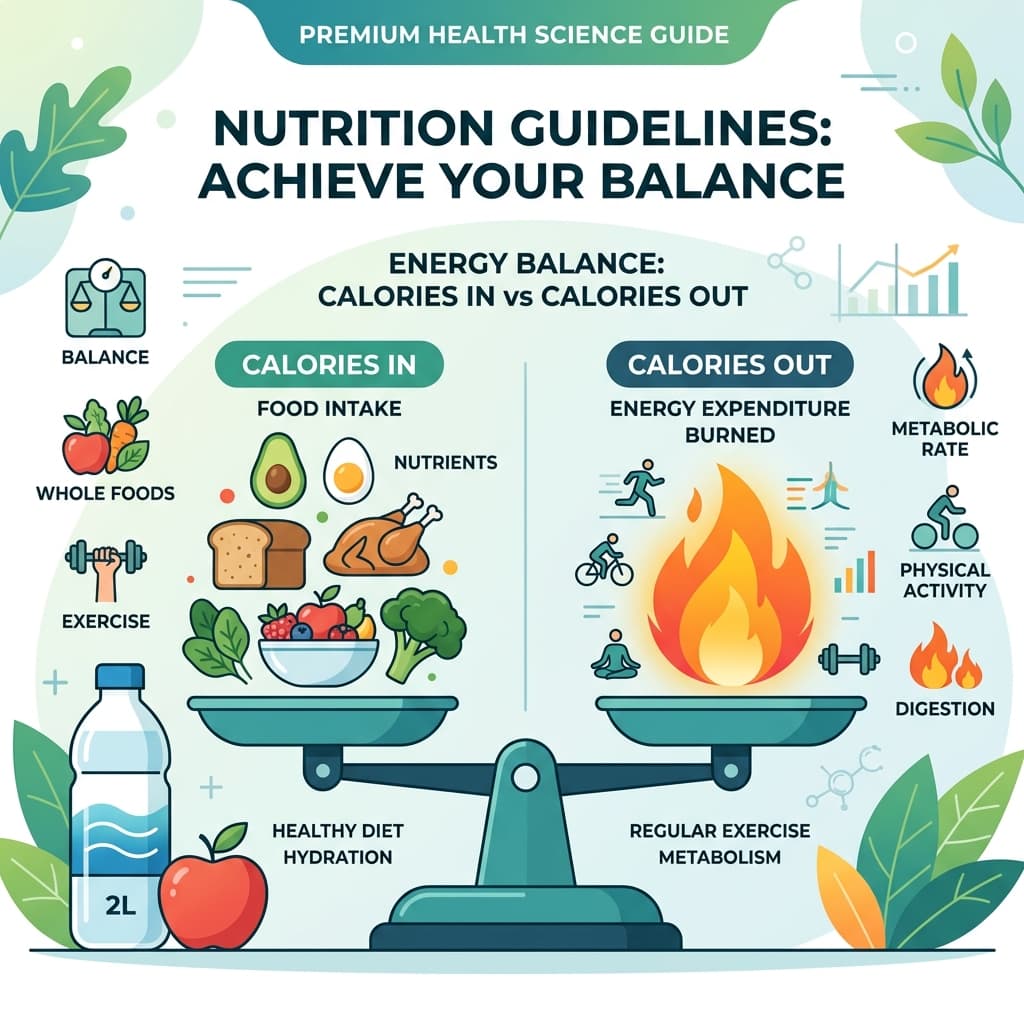
The Fundamental Rule of Thermodynamics
Regardless of what the latest fad diets suggest, the universal physiological law of weight loss remains unchanged: to lose weight, you must be in a caloric deficit. This simply means consuming fewer calories (energy) than your body expends on a daily basis.
When deprived of immediate energy from food, your body is forced to mobilize its stored energy reserves. In a healthy, protein-adequate diet, this energy is drawn almost exclusively from stored body fat.
How to Calculate Your Maintenance Calories (TDEE)
Before you can implement a deficit, you must know your baseline. This is known as your Total Daily Energy Expenditure (TDEE). Your TDEE is comprised of three main components:
- Basal Metabolic Rate (BMR): The energy your body burns just staying alive (breathing, pumping blood, organ function). This accounts for roughly 60-70% of your daily burn.
- Thermic Effect of Food (TEF): The energy required to digest, absorb, and dispose of ingested nutrients. Protein has the highest TEF.
- Activity Energy Expenditure (AEE): Everything else. This includes your gym workouts, walking to the bus, and even fidgeting throughout the day.
Rather than guessing, we strongly advise using our algorithmic calculator which utilizes the Mifflin-St Jeor equation—clinically proven to be the most accurate standard estimation formula available today.
Setting a Sustainable Target
The most common mistake beginners make is dropping their calories too low. Extreme deficits (e.g., eating 800-1000 calories a day) are a recipe for disaster.
Why? Because the human body is an incredibly adaptive survival machine. If you starve it, it will respond by down-regulating your metabolism, breaking down valuable muscle tissue for quick energy, and increasing your hunger hormones (Ghrelin) to unbearable levels.
The NHS Gold Standard (UK)
In the UK, the NHS Weight Loss Plan advocates for a steady, sustainable loss of 0.5kg to 1kg (1lb to 2lbs) per week.
To achieve this, you need a daily deficit of approximately 500 to 600 calories. If your maintenance TDEE is 2,200 calories, your daily target should be no lower than 1,600 calories. This allows you to lose fat predictably while maintaining your energy, mood, and critical muscle mass.
Tracking and Consistency
Understanding your target is only half the battle. You must track your intake accurately.
Invest in a digital kitchen scale. Eyeballing a tablespoon of peanut butter can easily be the difference between a 300 kcal deficit and eating precisely at maintenance. Track consistently for 2 weeks, monitor the scale (and how your clothes fit), and adjust your baseline up or down by 100 calories as needed.
Expert Tip
Don't stress over a single day. Think of your deficit as a weekly budget. If you overeat by 300 calories on Saturday, you haven't "ruined" your diet. You simply need to reduce your intake by 100 calories on Sunday, Monday, and Tuesday to balance the weekly spreadsheet. Consistency always beats perfection.
Frequently Asked Questions
Here are some of the most common questions our UK dietary experts receive regarding caloric deficits...
Is calculating my BMR completely accurate?
Equations like Mifflin-St Jeor are highly accurate estimations, usually within 10% of your true metabolic rate. However, extreme outliers in muscle mass or hormonal imbalances may require lab testing for absolute precision.
Does the UK NHS support calorie counting?
Yes, the NHS weight loss plan is fundamentally based on creating a daily deficit. They generally recommend a limit of 1,400 kcal a day for women and 1,900 kcal for men to achieve safe and sustainable fat loss.
Can I just eat junk food as long as I'm in a deficit?
Scientifically, yes—you will lose weight. However, your body composition, energy levels, and long-term health will suffer. 1,500 calories of lean protein and vegetables will make you feel vastly different than 1,500 calories of pure sugar.
Written by Dr. Alan Richards
Expert writer and contributor at CalZone, specialized in creating accurate tools and simple guidelines for UK readers.
Calorie Deficit Calculator
Ready to find your numbers? Use our clinical-grade calculator to find your exact daily caloric targets instantly.
Open Calculator FreeExplore CalZone's Free Specialist Calculators
Plan your finances, property renovations, health goals, and daily commute with our 300+ free UK tools.