
How Much Mortgage Can I Borrow Based on My Salary? UK Guide
Wondering how much mortgage you can actually get? Most UK lenders will offer between 4 and 4.5 times your gross annual salary as a standard maximum. Here's exactly how UK lenders calculate what they'll lend you in 2026.
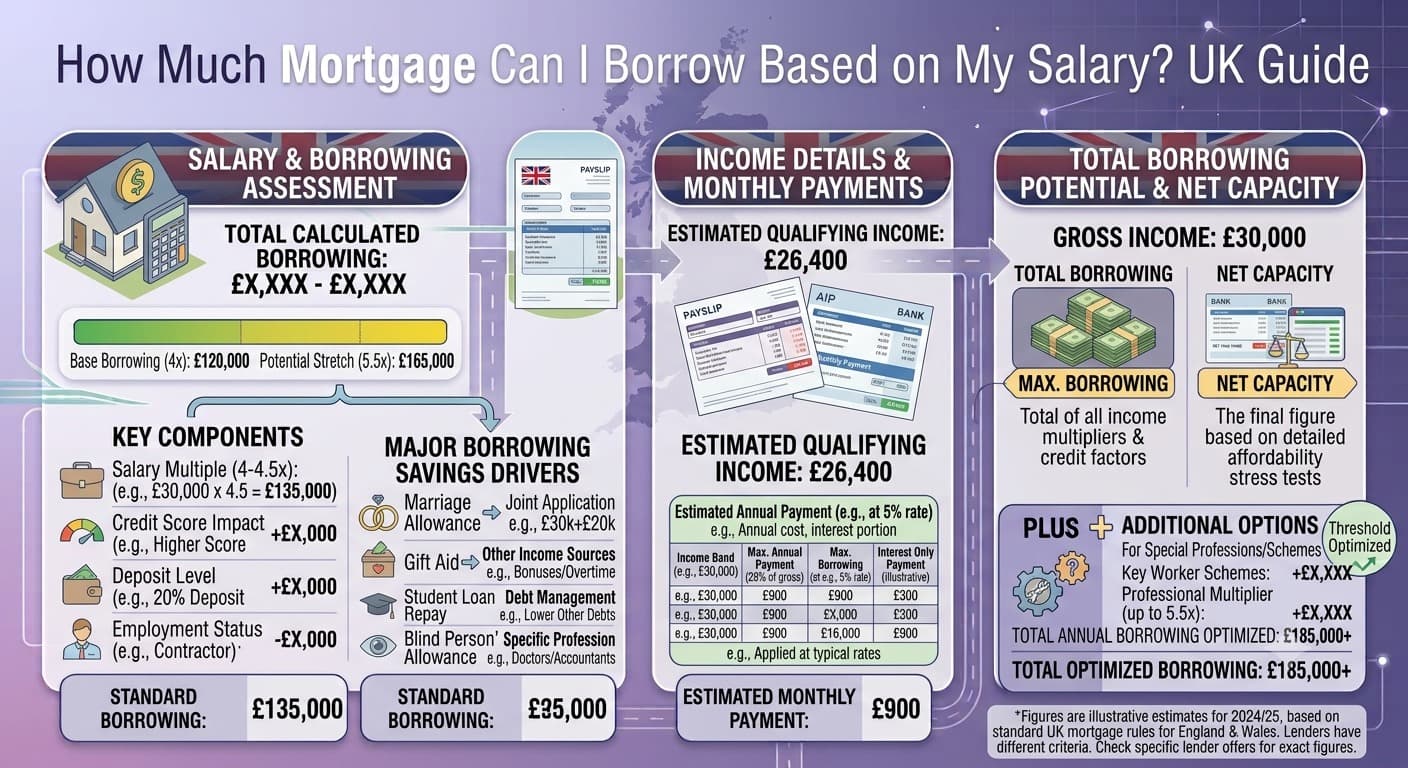
Most UK lenders will offer between 4 and 4.5 times your gross annual salary as a standard maximum mortgage. So on a £40,000 salary, that's typically £160,000–£180,000. Some lenders now stretch to 5x, 5.5x, or even 6x income for higher earners, professionals, and those with larger deposits — but your final figure also depends on your deposit, existing debts, credit history, and a lender's affordability stress test, not salary alone.
At CalZone, we know that getting mortgage-ready is as much about understanding your finances as it is about your salary — so here's exactly how UK lenders calculate what they'll lend you in 2026.
The Short Version: Borrowing by Salary at a Glance
| Gross Annual Salary | 4x Income | 4.5x Income | 5x Income (select lenders) |
|---|---|---|---|
| £25,000 | £100,000 | £112,500 | £125,000 |
| £30,000 | £120,000 | £135,000 | £150,000 |
| £35,000 | £140,000 | £157,500 | £175,000 |
| £40,000 | £160,000 | £180,000 | £200,000 |
| £50,000 | £200,000 | £225,000 | £250,000 |
| £60,000 | £240,000 | £270,000 | £300,000 |
| £75,000 | £300,000 | £337,500 | £375,000 |
| £100,000 | £400,000 | £450,000 | £500,000 |
These are indicative starting points, not guaranteed offers. Your actual maximum depends on the full affordability picture a lender runs on your application.
How UK Lenders Actually Calculate Your Mortgage
Mortgage lending in the UK isn't just "salary × a fixed number." It works on three layers stacked on top of each other.
- 1. The Bank of England's Loan-to-Income (LTI) Limit: The Bank of England's Financial Policy Committee has long recommended that lenders limit the proportion of mortgages issued at 4.5 times income or above to a set share of their total new lending — commonly referred to as the loan-to-income "flow limit." This exists to stop household debt building up to unsustainable levels across the market, not to cap any single borrower directly.
- 2. The FCA's Affordability Rules (MCOB 11.6): Under FCA conduct rules, every lender must verify your income, assess your committed spending, and run a forward-looking interest rate stress test before offering a mortgage. This means lenders check you could still afford repayments if rates rose — not just whether you can afford today's rate.
- 3. Each Lender's Own Risk Model: On top of the regulatory framework, each lender applies its own internal income multiple, stress margin, and expenditure benchmarks. This is why two people earning identical salaries can receive very different maximum offers from different lenders.
Standard Income Multiples in 2026
| Multiple | Who Typically Qualifies |
|---|---|
| 4.0x–4.5x | Standard high street default for most employed applicants |
| 4.75x–5x | Higher earners (often £50,000+ individually or £75,000–£80,000 joint income) |
| 5.5x | Some mainstream lenders as standard; also common for professional mortgage schemes |
| 6x–6.5x | Select lenders, often for premier banking clients or specific professions (doctors, lawyers, accountants, dentists) with income above roughly £75,000–£100,000 |
Professional mortgage schemes exist specifically because lenders view certain qualified professions as lower-risk borrowers with predictable, rising income — this can unlock a higher multiple even without a huge deposit.
What Else Affects How Much You Can Borrow
Your income multiple is only the starting point. Lenders then adjust based on:
- Existing Debts and Commitments: Credit cards, car finance, personal loans, student loan repayments, and even Buy Now Pay Later balances all reduce your available income in a lender's eyes. As a rough guide, around £500 a month in existing debt repayments can reduce your maximum mortgage by roughly £100,000–£120,000, because lenders assume that money will never be available for mortgage repayments.
- Deposit Size and Loan-to-Value (LTV): The percentage of the property's value you need to borrow — your Loan-to-Value ratio — directly affects your options. A £50,000 deposit on a £250,000 property creates a £200,000 mortgage, or 80% LTV. A bigger deposit means a lower LTV, which typically opens up better rates and, in some cases, higher income multiples too.
- Credit History: A clean credit history, being on the electoral roll, and low existing utilisation on credit cards all help. Missed payments, high card balances, or a thin credit file can reduce the amount — or number of lenders — willing to offer you a mortgage at all.
- Employment Type: Employed applicants generally need 3 months of payslips and P60s. Self-employed applicants (sole traders and company directors) usually need two to three years of finalised accounts or SA302 tax calculations, with lenders assessing either salary and dividends or a share of net company profit. Contractors may be assessed on day rate or annualised contract income, depending on the lender.
- Joint Applications: If you're buying with a partner, most lenders combine both incomes before applying the multiple. A couple earning £45,000 and £55,000 — £100,000 combined — could access roughly £400,000 at a 4x multiple or £450,000 at 4.5x, which can be the difference between a flat and a house in a more expensive region.
Worked Example: £60,000 Salary
Let's say you earn £60,000 a year, have no existing debts, and a 15% deposit.
- Standard 4.5x multiple: £60,000 × 4.5 = £270,000 maximum mortgage
- Enhanced 5.5x multiple (if eligible): £60,000 × 5.5 = £330,000 maximum mortgage
- Add your deposit (say £48,000, based on 15% of a roughly £320,000 property) to see the total property price your borrowing could support.
The gap between a 4x and a 5.5x multiple on the same salary can be well over £100,000 — often the difference between property types or locations entirely.
How to Increase How Much You Can Borrow
- Pay down existing debt before applying — even clearing one credit card or loan can materially raise your maximum.
- Apply jointly with a partner if you're buying together, since combined income raises the base multiple calculation.
- Improve your credit score, including registering on the electoral roll and reducing credit utilisation, well before you apply.
- Save a larger deposit to improve your LTV and access better rates and, sometimes, higher multiples.
- Use a mortgage broker who knows which lenders offer higher multiples for your specific income level or profession.
- Check professional mortgage schemes if you work in an eligible profession — these can unlock significantly higher multiples.
Why Getting Mortgage-Ready Starts with Your Everyday Finances
Before any lender looks at your income multiple, they'll look at your bank statements, spending patterns, and existing commitments. This is where day-to-day money habits matter as much as your headline salary. CalZone is built to help people in the UK get a clear, honest picture of their spending and saving so that when it's time to apply for a mortgage, there are no surprises in their bank statements — and no last-minute scramble to tidy up finances before a lender looks at them.
This guide reflects general UK mortgage lending criteria and income multiples observed across the market in 2026. Actual lending decisions depend on individual lender policy, affordability assessments, and your personal financial circumstances. It's provided for general information only and doesn't constitute financial or mortgage advice — speak to a qualified mortgage broker or adviser for guidance specific to your situation.
Common Questions
How much mortgage can I get based on my salary in the UK?
Most UK lenders offer 4 to 4.5 times your gross annual salary as standard, though some lenders extend this to 5x, 5.5x, or even 6x income for higher earners, certain professions, or borrowers with strong affordability profiles.
Is it always 4.5 times my salary for a mortgage?
No. 4.5x is the long-standing high street default, but it isn't a hard ceiling. Several UK lenders now offer up to 5.5x as standard, and up to 6x-6.5x for specific borrower profiles such as high earners or qualifying professionals.
Does my partner's income count toward our mortgage?
Yes, if you're applying jointly. Lenders combine both incomes and apply the income multiple to the total, which usually increases the maximum mortgage compared with a single application.
Do existing debts reduce how much I can borrow?
Yes. Credit cards, car finance, loans, and similar commitments reduce your available income in a lender's assessment. Roughly £500 a month in existing debt can lower your maximum mortgage by approximately £100,000–£120,000.
Can self-employed people borrow the same multiple as employed applicants?
Often yes, but the assessment is different. Lenders typically need two to three years of accounts or SA302s and will look at salary plus dividends, or a share of net company profit, rather than a single payslip figure.
Does a bigger deposit mean I can borrow more?
A bigger deposit lowers your Loan-to-Value ratio, which usually secures better interest rates and can, with some lenders, unlock a higher income multiple — though the core salary-based maximum tends to stay similar regardless of deposit size.
Written by Sulzax
Expert writer and contributor at CalZone, specialized in creating accurate tools and simple guidelines for UK readers.
iSources & References
Mortgage Calculator UK
Ready to test your affordability and see monthly payments? Use our comprehensive Mortgage Calculator UK.
Open Calculator FreeExplore CalZone's Free Specialist Calculators
Plan your finances, property renovations, health goals, and daily commute with our 300+ free UK tools.