
How to Read Your UK Payslip: Every Deduction Explained
Confused by your UK payslip? Calzone breaks down every deduction, from tax codes to National Insurance and pensions, so you know where your money goes.
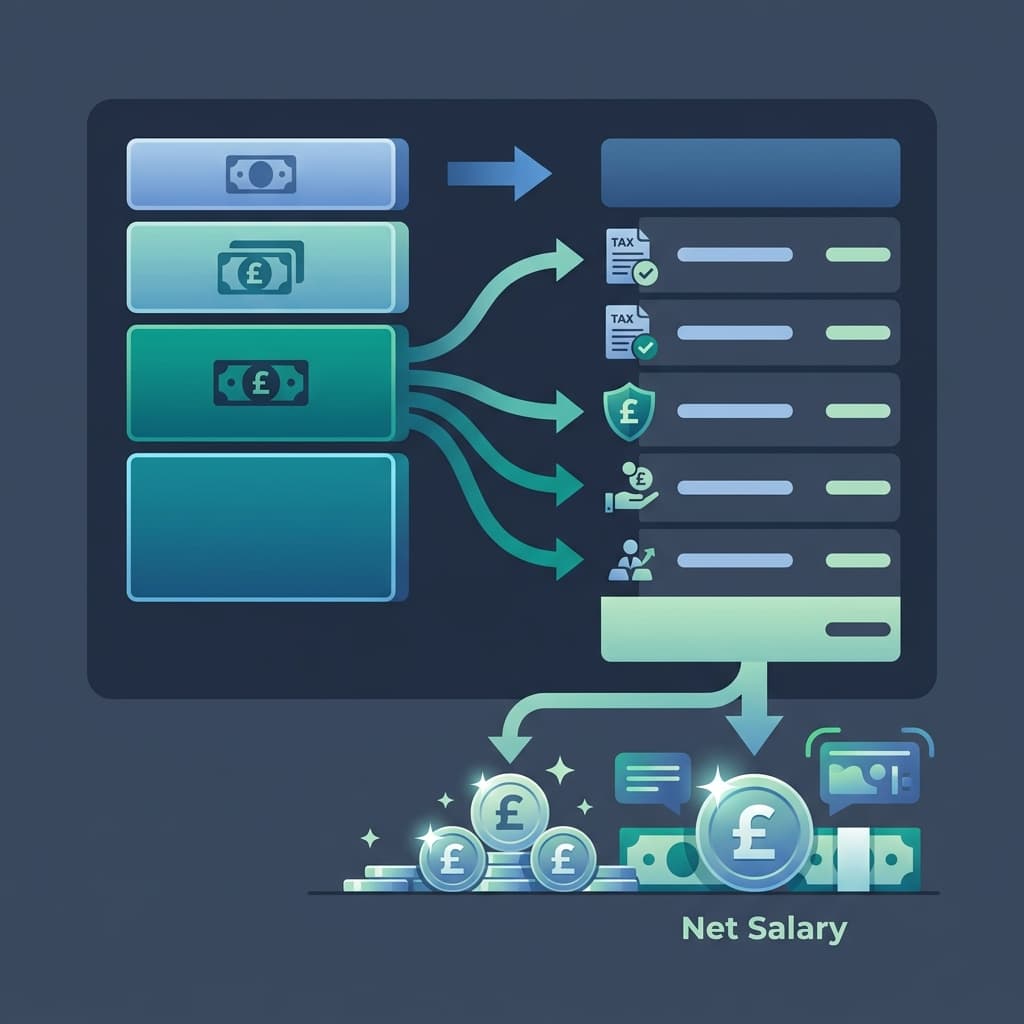
Welcome to CalZone's ultimate UK guide on How to Read Your UK Payslip: Every Deduction Explained. Designed and compiled by Sulzax_Dev, this comprehensive guide breaks down verified UK rules, official statistics, and practical strategies to help you navigate your decisions smoothly.
How to Read Your UK Payslip: Every Deduction Explained
Opening your payslip and seeing your gross pay shrink into a much smaller "net pay" figure can feel like a small act of financial magic — except nobody explained the trick. If you've ever stared at a column of unfamiliar codes, percentages, and abbreviations and wondered where exactly your money went, you're not alone. Millions of UK employees are paid every month without ever fully understanding how to read a UK payslip.
At Calzone, we believe understanding your money is the first step to managing it well. This guide walks through every line of a typical UK payslip — from gross pay to net pay — so you can check it's correct, spot errors early, and finally understand where every pound goes.
Why Understanding Your Payslip Actually Matters
A payslip isn't just a formality your employer hands over each month — it's a legal document and a financial record. Under UK law, every employee is entitled to an itemised payslip, either on or before payday, showing gross pay, deductions, and net pay. Employers are legally required to provide this under the Employment Rights Act, and the rules are set out clearly by the UK government's payslip guidance.
Understanding your payslip helps you:
Catch payroll errors before they cost you money (miscalculated tax, missed pension contributions, or an out-of-date tax code are more common than most people realise)
Budget accurately by knowing your true take-home pay rather than guessing from your salary headline figure
Plan for the future, whether that's a mortgage application, a pension review, or simply building better monthly habits inside an app like Calzone
Spot underpayment or overpayment of tax, National Insurance, or student loan contributions
The Anatomy of a UK Payslip
While formats vary between employers and payroll software, almost every UK payslip contains the same core sections. Let's go through them one by one.
1. Personal and Employer Details
At the top, you'll usually find your name, employee number, National Insurance number, tax code, and pay date, alongside your employer's name and PAYE reference. It's worth checking these details are correct, particularly your National Insurance number and tax code, since errors here can cause real payroll problems down the line.
2. Gross Pay
Gross pay is your total earnings before any deductions are taken out. This includes your basic salary or hourly wage, plus any overtime, bonuses, commission, or other taxable payments made in that period. Gross pay is the starting point for every calculation that follows — it's the number your tax, National Insurance, and pension contributions are all worked out from.
3. Your Tax Code
Just above or beside your gross pay, you'll see a tax code — something like 1257L, the most common code for the 2025/26 tax year, representing the standard tax-free Personal Allowance. The letters and numbers tell HMRC's payroll system how much of your income is tax-free before deductions kick in.
Numbers relate to how much tax-free income you're allowed (multiply by 10 to get the approximate allowance)
Letters indicate your specific circumstances — for example, L for the standard allowance, M or N for Marriage Allowance transfers, BR if all your income is taxed at the basic rate (common for second jobs), or K if you owe tax from a previous year
If your tax code looks unfamiliar or hasn't changed in years despite a change in circumstances (a new job, company benefits, or marriage), it's worth checking it against HMRC's tax code guidance — an incorrect code is one of the most common payslip errors in the UK.
The Deductions: Where Does the Money Actually Go?
This is the section most people skim past without really reading — but it's where the real story of your payslip lives.
Income Tax (PAYE)
Income Tax is deducted through the Pay As You Earn (PAYE) system, meaning your employer calculates and pays it directly to HMRC before you ever see the money. For the 2025/26 tax year, most people in England, Wales, and Northern Ireland pay:
0% on earnings up to the Personal Allowance (£12,570)
20% basic rate on income between £12,571 and £50,270
40% higher rate on income between £50,271 and £125,140
45% additional rate above £125,140
Scotland has its own income tax bands set by the Scottish Parliament, so if your payslip shows an S prefix on your tax code (e.g. S1257L), your rates and thresholds will differ slightly. Full current rates are published on gov.uk's Income Tax page.
National Insurance (NI) Contributions
National Insurance funds state benefits including the State Pension, and it's calculated separately from Income Tax. Most employees pay Class 1 National Insurance, deducted automatically based on your earnings in each pay period. You'll usually see a category letter (most commonly A) next to your NI deduction, which reflects your employment circumstances.
Unlike Income Tax, NI is calculated per pay period rather than cumulatively across the year, which is why your take-home pay can vary slightly if your earnings fluctuate month to month. You can find the current thresholds and rates on gov.uk's National Insurance page.
Pension Contributions
If your employer offers a workplace pension — which, thanks to auto-enrolment, almost all UK employers must — you'll typically see two pension lines, or one combined figure:
Your contribution, usually a percentage of your qualifying earnings (the statutory minimum is currently 5%)
Your employer's contribution, which doesn't come out of your pay but is often shown for transparency (statutory minimum 3%)
Pension contributions are usually deducted before tax is calculated if your scheme uses "salary sacrifice" or "net pay arrangement," which effectively lowers your taxable income and reduces your Income Tax bill slightly. If your scheme uses "relief at source," contributions are taken after tax, and basic-rate tax relief is added into your pension pot separately.
Student Loan Repayments
If you have a student loan and you're earning above the relevant repayment threshold, you'll see a Student Loan deduction, usually labelled Plan 1, Plan 2, Plan 4, Plan 5, or Postgraduate Loan depending on when and where you studied. Repayments are calculated as 9% (6% for Postgraduate Loans) of income above the threshold, deducted automatically through PAYE — you don't need to do anything manually.
Other Common Deductions
Depending on your circumstances, you might also see:
Union subscriptions if you're a member of a trade union with a payroll deduction arrangement
Court orders or Attachment of Earnings Orders, deducted if you have certain debts recovered through your wages
Salary sacrifice benefits, such as cycle-to-work schemes, childcare vouchers, or additional pension contributions, which reduce your taxable pay
Season ticket loans or company benefit repayments, if your employer has advanced you money for a benefit in kind
Understanding Net Pay and Year-to-Date Figures
After all deductions are subtracted from your gross pay, what's left is your net pay — the amount that actually lands in your bank account. This is the figure that matters most for day-to-day budgeting, which is exactly why tools like Calzone focus on your real take-home income rather than your headline salary when helping you plan your spending.
Most payslips also include year-to-date (YTD) figures, showing your cumulative gross pay, tax paid, and National Insurance contributions since the start of the tax year (6 April). These figures are particularly useful for:
Checking whether you're on track to pay the correct amount of tax annually
Completing a Self Assessment tax return if you have additional income
Applying for a mortgage or loan, where lenders often ask for several months of payslips
A Quick Glossary of Payslip Terms
Term
Meaning
Gross pay
Total earnings before deductions
Net pay
Take-home pay after all deductions
Tax code
Determines how much tax-free income you get
PAYE
The system used to collect Income Tax and NI
NIC
National Insurance Contributions
YTD
Year-to-date cumulative totals
Payroll number
Your unique employee identifier
Frequently Asked Questions
What's the difference between gross pay and net pay? Gross pay is your total earnings before any deductions. Net pay is what's left after Income Tax, National Insurance, pension contributions, and any other deductions have been taken out — it's the amount actually paid into your bank account.
Why has my tax code changed? Tax codes change for several reasons: a new job, a change in company benefits, an underpayment or overpayment of tax from a previous year, or HMRC updating your Personal Allowance. If you're unsure why yours has changed, you can check your tax code online through your personal tax account on gov.uk.
Can I check if my payslip is correct? Yes. Compare your gross pay, tax code, and deductions against the current year's rates on gov.uk, or use an independent tax calculator such as those listed on MoneyHelper, the UK's free, government-backed money guidance service. If figures don't add up, raise it with your payroll or HR team promptly.
Do all UK employees get a payslip? Yes — it's a legal right. Employers must provide an itemised payslip on or before payday, whether digital or paper, showing gross pay, deductions, and net pay.
Why does my take-home pay change each month even though my salary is the same? This can happen for several reasons: different numbers of working days in a month, overtime or bonuses, changes to your tax code, or National Insurance being calculated per pay period rather than averaged across the year.
Take Control of What Happens After Payday
Understanding your payslip is only half the story — what you do with your net pay each month is where the real financial progress happens. That's exactly where Calzone comes in. Once you know exactly what's landing in your account and why, our tools help you turn that clarity into a plan: tracking spending, building savings habits, and making your take-home pay work harder for you.
If you found this guide useful, explore more practical money guidance on the Calzone blog, or head to our homepage to see how Calzone helps UK employees manage their finances with confidence, one payslip at a time.
This article is for general information only and does not constitute financial or tax advice. For guidance specific to your circumstances, consult HMRC or a qualified financial adviser.
____________________
Explore CalZone's 40+ UK Specialist Tools & Guides
Access our complete suite of verified UK calculators for quick, accurate calculations across finance, health, energy, housing, and lifestyle:
- Salary Calculator UK
- Income Tax Calculator UK
- Take-Home Pay Calculator
- National Insurance Calculator
- Mortgage Calculator UK
- Mortgage Repayment Calculator
- Stamp Duty Calculator UK
- Capital Gains Tax Calculator
- Share Dealing Fee Calculator
- Portfolio Return Calculator UK
- Dividend Tax Calculator UK
- VAT Calculator UK
- Payslip Calculator UK
- Minimum Wage Calculator UK
- Statutory Sick Pay Calculator
- Solar Panel Cost Calculator UK
- Solar Payback Period Calculator
- EV Charging Cost Calculator UK
- Car Road Tax Calculator UK
- Fuel Cost Calculator UK
- Car Insurance Cost Calculator
- Bathroom Renovation Cost Calculator
- Kitchen Extension Cost Calculator
- Conservatory Cost Calculator UK
- EPC Improvement Calculator UK
- Boiler Replacement Cost Calculator
- Concrete Calculation Guide
- BMI Calculator UK
- BMR & Calorie Deficit Calculator
- Body Fat Percentage Calculator
- UK School Age Calculator
- Child School Start Date Calculator
- Big Three Astrology Calculator
- Sun Sign Calculator
- Moon Sign Calculator
- Rising Sign Calculator
- Venus Sign Calculator
- Chiron Sign Calculator
- Lilith Sign Calculator
- North Node Calculator
- Part of Fortune Calculator
- Vertex Sign Calculator
- Fence Panel Calculator UK
- Post & Rail Fencing Calculator
- Picket Fence Calculator UK
- Trellis Panel Calculator UK
Written by Sulzax_Dev
Sulzax_Dev is a lead software engineer, calculator enthusiast, and data analyst. He designs high-precision tracking tools and writes deep analytical guides to simplify complex financial, health, and astrological calculations.
iSources & References
- [1]GOV.UK — Income Tax Rates & Personal Allowances
- [2]GOV.UK — National Insurance Rates & Thresholds
- [3]GOV.UK — Statutory Maternity Pay & Leave
- [4]GOV.UK — Council Tax Bands & Valuation List
- [5]GOV.UK — National Minimum Wage & Living Wage Rates
- [6]GOV.UK — Marriage Allowance Claim & Eligibility
- [7]GOV.UK — Stamp Duty Land Tax (SDLT) Rates
- [8]GOV.UK — Vehicle Excise Duty (Road Tax) Rates
- [9]GOV.UK — Energy Performance Certificates (EPC) Register
- [10]GOV.UK — Statutory Sick Pay (SSP) Rates
- [11]GOV.UK — State Pension Rates & Qualifying Years
- [12]GOV.UK — School Admissions Code & Application Rules
- [13]ONS — Annual Survey of Hours and Earnings (ASHE)
- [14]ONS — Consumer Price Inflation (CPI) UK
- [15]ONS — UK House Price Index
- [16]Bank of England — Official Bank Rate & Monetary Policy
- [17]Ofgem — Energy Price Cap & Tariff Updates
- [18]HMRC — Payslip & Tax Code Breakdown Guide
- [19]MoneyHelper — UK Budgeting & Personal Finance Advice
- [20]MoneyHelper — Investing & Share Dealing Basics
- [21]MoneyHelper — Shared Ownership & Housing Schemes
- [22]Citizens Advice — Understanding Your Payslip & Taxes
- [23]Citizens Advice — Council Tax Band Appeals & Discounts
- [24]Which? — Best Share Dealing Platforms UK
- [25]Which? — Home Energy Efficiency & EPC Ratings
- [26]Which? — Solar Batteries & Solar PV Savings Guide
- [27]Energy Saving Trust — Solar Battery Storage Guide
- [28]Energy Saving Trust — EPC Rating Improvement Tips
- [29]Financial Conduct Authority (FCA) — Investment Rules
- [30]NHS — Healthy Weight & BMI Guidance
- [31]NHS — Maternity & Pregnancy Benefits Guide
- [32]Department for Education — School Year Groups & Primary Admissions
- [33]RAC — UK Fuel Price Tracker & Journey Planning
- [34]AA — UK Speeding Fines & Penalty Point Guide
- [35]Astrological Association UK — Birth Chart & Planetary History
- [36]London Stock Exchange (LSE) — FTSE 100 Market Data
- [37]Valuation Office Agency (VOA) — Council Tax Bands
- [38]Homes England — Affordable Home Ownership Programs
- [39]Advisory, Conciliation and Arbitration Service (ACAS) — Payslips
- [40]Motorists' Legal Protection — Speed Awareness Course Guide
- [41]Ofsted — UK School Inspection Reports & Admission Standards
- [42]Microgeneration Certification Scheme (MCS) — Solar Quality
- [43]Smart Energy GB — Smart Meter & Home Battery Benefits
- [44]Building Research Establishment (BRE) — Standard Assessment Procedure (SAP)
- [45]Association of British Insurers (ABI) — Motor Claims Data
Explore CalZone's Free Specialist Calculators
Plan your finances, property renovations, health goals, and daily commute with our 300+ free UK tools.