
Net vs Gross Salary UK: What's the Real Difference?
Confused about net vs gross salary UK? See the real difference, a full 2026/27 pay breakdown, and calculate your exact take-home pay with CalZone.
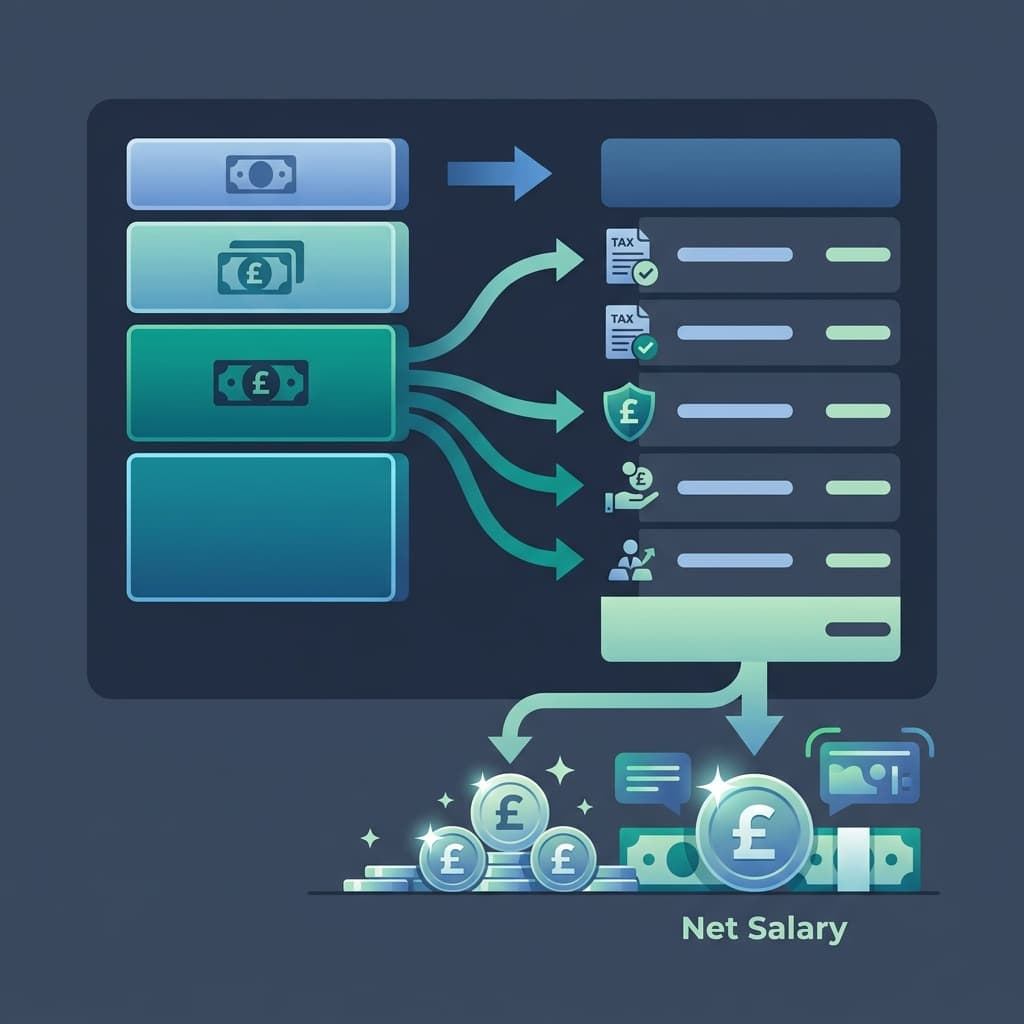
You open a job offer and see "£35,000." Then payday arrives and the number hitting your bank account is nowhere near £35,000 divided by 12. If that gap has ever confused you, you're not alone — net vs gross salary is one of the most searched pay questions in the UK, and for good reason. The difference between what you're offered and what you actually keep can change how you budget, negotiate, and plan your entire financial year.
At CalZone, we built our free Salary Calculator UK specifically to answer this question in seconds. But numbers are more useful when you understand what's behind them, so here's the full breakdown of gross pay, net pay, and everything HMRC takes out in between.
What Is Gross Salary?
Gross salary is your total pay before any deductions. It's the headline figure you'll see in a job advert, an employment contract, or a payslip's top line. If your contract says £35,000 a year, that £35,000 is your gross annual salary — the number your employer uses to calculate tax, National Insurance, and pension contributions.
Gross salary includes:
- Your base annual pay
- Regular bonuses or commission (if contractual)
- Overtime pay
- Any taxable benefits added to your pay figure
It's the number recruiters quote, the number in salary benchmarking reports, and the number most people compare when weighing up two job offers. But it is not the amount that lands in your bank account. If you need to convert an hourly rate to check your gross equivalents, our Hourly to Salary Calculator or the inverse Salary to Hourly Calculator can help clarify.
What Is Net Salary?
Net salary, often called "take-home pay," is what's left after all mandatory deductions have been taken from your gross salary. This is the real number that matters for day-to-day budgeting — rent, bills, groceries, and savings all come out of net pay, not gross pay.
In the UK, the deductions between gross and net typically include:
- Income Tax — calculated using HMRC's tax bands via our Income Tax Calculator UK
- National Insurance (NI) — your contribution toward state benefits and the State Pension
- Workplace pension contributions — usually a percentage of qualifying earnings under auto-enrolment, which you can estimate using the Workplace Pension Calculator
- Student loan repayments — if you have an outstanding UK student loan and earn above the relevant threshold (see the Student Loan Calculator)
- Salary sacrifice arrangements — such as cycle-to-work schemes, company cars, or additional pension contributions
Once all of these are subtracted, what remains is your net salary — the figure that actually shows up on payday.
Net vs Gross Salary UK: The Key Differences at a Glance
| Feature | Gross Salary | Net Salary |
|---|---|---|
| Definition | Total pay before deductions | Pay after all deductions |
| Where you see it | Job adverts, contracts, payslip top line | Bank account, payslip bottom line |
| Used for | Salary comparisons, mortgage applications, pension calculations | Budgeting, everyday spending |
| Includes tax and NI? | No | Deducted already |
| Typical difference | Higher figure | 20–35% lower than gross, depending on income |
This is the core of the net vs gross salary UK question: gross is the number on paper, net is the number in your pocket. Understanding both matters because lenders, landlords, and even the DWP sometimes ask for gross income, while your personal budget should always be built around net income.
A Real 2026/27 Example: Gross to Net Salary UK
Let's turn this into a concrete example using the 2026/27 tax year rates. For most of the UK (England, Wales, and Northern Ireland), the current thresholds are:
- Personal Allowance: £12,570 tax-free
- Basic Rate (20%): £12,571 to £50,270
- Higher Rate (40%): £50,271 to £125,140
- Additional Rate (45%): above £125,140
- Employee National Insurance: 8% on earnings between £12,570 and £50,270, then 2% above that
Say someone earns a gross salary of £35,000 a year, with no student loan and a standard 5% workplace pension contribution.
- Income Tax: The first £12,570 is tax-free. The remaining £22,430 is taxed at 20%, which comes to roughly £4,486.
- National Insurance: 8% is charged on earnings above £12,570, which works out to around £1,794.
- Pension contribution: 5% of qualifying earnings, roughly £1,122.
- Take-home (net) pay: After these deductions, the employee is left with approximately £27,600 a year, or about £2,300 a month — noticeably less than the £2,917 a month that £35,000 gross might suggest at first glance.
This is exactly the kind of gap that catches people off guard when comparing a new job offer to their current one. Running the exact numbers for your own salary — including student loan repayments, Scottish tax rates, or a different pension percentage — takes seconds with our Income Tax Calculator UK or the full Salary Calculator UK.
Why the Net vs Gross Difference Actually Matters
- Job offers can be misleading if you only compare gross figures. A £40,000 offer with no pension match and a long commute might net out lower than a £37,000 offer with strong benefits. Always compare net pay and total package, not just the headline gross number.
- Mortgage and rental applications use gross income. Lenders typically calculate affordability based on gross salary, while you'll be repaying that mortgage out of net income. Knowing both figures helps you sanity-check what you can genuinely afford — our Mortgage Calculator UK is a useful next step here.
- Payslips can be confusing without context. If you've ever looked at your payslip and wondered why so much has been deducted, understanding the gross-to-net breakdown makes every line make sense — tax, NI, pension, and any student loan repayment.
- Pay rises don't translate pound-for-pound into take-home pay. A £2,000 gross pay rise won't add £2,000 to your net income once tax and NI are applied — especially if it pushes part of your income into a higher tax band.
- Freelancers and contractors need to think in net terms. If you're comparing a permanent salary to a day rate, converting both to net, after-tax equivalents is the only fair comparison. You can estimate freelancer tax using the Self Employed Tax Calculator UK or check dividend payments via the Dividend Tax Calculator.
Does Location or Student Loans Change the Gross-to-Net Gap?
Two factors catch a lot of people out when comparing their gross salary to their expected net pay.
Scotland uses different Income Tax bands. If your main home is in Scotland, your Income Tax is calculated using Scottish rates and thresholds rather than the England, Wales, and Northern Ireland bands used in the example above. These bands include more tiers and can result in a slightly different net figure for the same gross salary, even though National Insurance is calculated the same way UK-wide.
Student loan repayments reduce net pay further. If you have a Plan 1, Plan 2, Plan 4, or Postgraduate Loan, repayments are automatically deducted once your income passes the relevant threshold — typically calculated as a percentage of everything you earn above that threshold, on top of Income Tax and National Insurance. This is one of the most commonly forgotten deductions when people estimate their own take-home pay by hand, which is another reason a dedicated calculator tends to be more reliable than back-of-envelope maths.
How to Calculate Net Salary From Gross Pay
You can estimate your own net pay manually using this sequence:
- Start with your gross annual salary.
- Subtract your Personal Allowance (usually £12,570) to find your taxable income.
- Apply the relevant Income Tax bands (20%, 40%, 45%) to that taxable income.
- Calculate employee National Insurance separately, using the 8% and 2% thresholds.
- Subtract any workplace pension contributions and student loan repayments.
Doing this by hand is easy to get wrong, especially with pension percentages, student loan plans, or Scottish tax bands added into the mix. That's exactly why our free Salary Calculator UK exists — enter your gross salary once and get an instant, accurate net pay breakdown built around current UK tax rules.
Gross vs Net: Common Questions Answered
Is gross salary the same as your annual income? Not exactly. Gross salary usually refers to pay from a specific job, while total annual income can include other sources like savings interest, rental income, or dividends, all of which affect your overall tax position.
Does gross salary include bonuses? Contractual and guaranteed bonuses are generally included in gross salary figures used for job offers, though discretionary or one-off bonuses may be listed separately and taxed in the pay period they're received.
Why is my net pay different every month even on a fixed salary? Overtime, bonus payments, changes to tax codes, pension contribution adjustments, or crossing into a new tax year can all shift your monthly net pay slightly, even with an unchanged gross salary.
Should I negotiate based on gross or net salary? Negotiate the gross figure, since that's the standard employers work with, but always check the net impact afterward so you know what the offer genuinely means for your monthly budget.
Work Out Your Real Take-Home Pay Today
Understanding net vs gross salary UK rules puts you in control of every job offer, pay rise, and budgeting decision. Rather than estimating, get an exact figure based on current 2026/27 tax rates using CalZone's free Salary Calculator UK. You can also check your Income Tax, review minimum wage compliance, or generate a full payslip breakdown — all free, all built specifically for the UK.
Written by Sulzax
Expert writer and contributor at CalZone, specialized in creating accurate tools and simple guidelines for UK readers.
iSources & References
UK Salary Calculator
Calculate take-home pay, income tax, and national insurance.
Open Calculator FreeExplore CalZone's Free Specialist Calculators
Plan your finances, property renovations, health goals, and daily commute with our 300+ free UK tools.